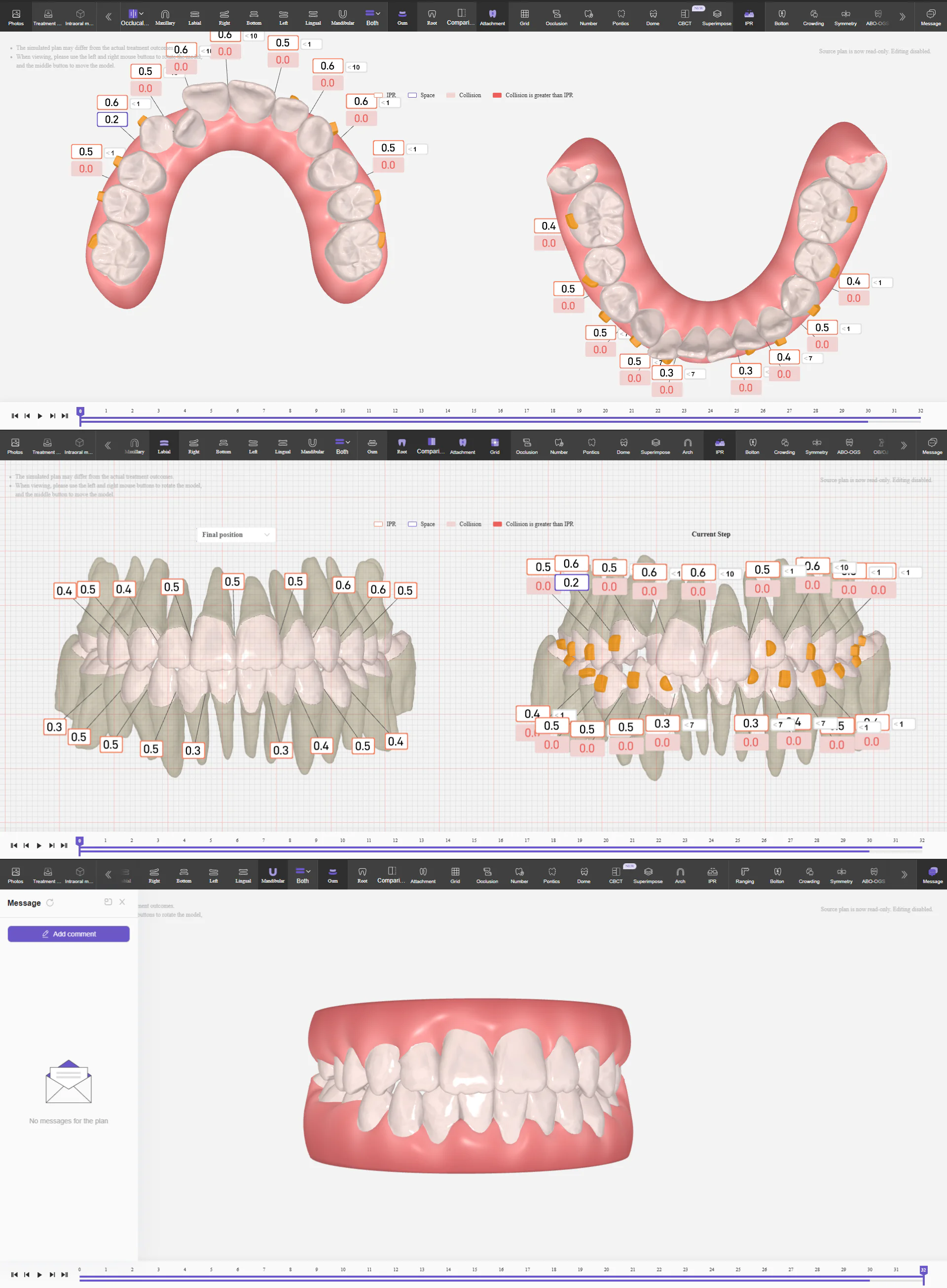
Most clinicians see only the final animation. Few understand the full workflow behind an AI-generated clear aligner plan.
1. Prescription Input
Before any computation, the system must capture the clinical directive: extraction protocol, expansion strategy, IPR tolerance, molar distalization, and anchorage requirements.
Many mid-treatment revisions trace back to incomplete or ambiguous input at this stage.
2. Model Preprocessing
This includes attachment removal, mesh repair, and occlusal plane orientation. A misoriented digital model propagates errors through every subsequent tooth axis and target position.
3. Segmentation & Target Setup
The AI identifies individual tooth boundaries, tooth numbering, edentulous spaces, and arch perimeter discrepancy. It then generates a baseline target occlusion based on crowding severity and the prescribed treatment objectives.
Target position validity remains fundamentally dependent on clinical experience.
4. Staging & Attachment Optimization
The algorithm calculates incremental tooth movement per stage and recommends attachment type and placement.
Attachments are biomechanical control auxiliaries. Clinical outcomes still depend on the clinician’s grasp of force systems and anchorage management.
What AI Actually Competes On
It is not automation. It is clinical logic, dataset depth, and quality control architecture.
The Hidden Problem: Alignment ≠ Treatment
Many clear aligner design platforms produce visually straight arches without respecting underlying biomechanical principles. The result is predictable: unnecessary refinements and case restarts, particularly in moderate and complex malocclusions.
This happens because effective AI clear aligner planning requires post-training on large, clinically validated datasets—ideally inclusive of CBCT imaging for root position and bone boundary awareness. Without sufficient CBCT-enriched patient data, AI systems default to superficial crown alignment rather than anatomically sound tooth movement.
Many clear aligner design software fail to follow clinical logic and merely straighten teeth, resulting in frequent unnecessary refinements and restarts, especially for moderate and complex cases. It is reasonable that AI clear aligner solutions tend to make errors on these cases without adequate post-training data incorporating CBCT scans. That makes Best Smile Tech’s AI design software particularly outstanding: it runs intelligently and strictly follows the medical logic of clear aligner treatment. CBCT and intraoral scanners are widely adopted across China, and data compliance rules are less rigorous here. Hence, industry leader Align Technology has established its R&D center for AI design software in China.