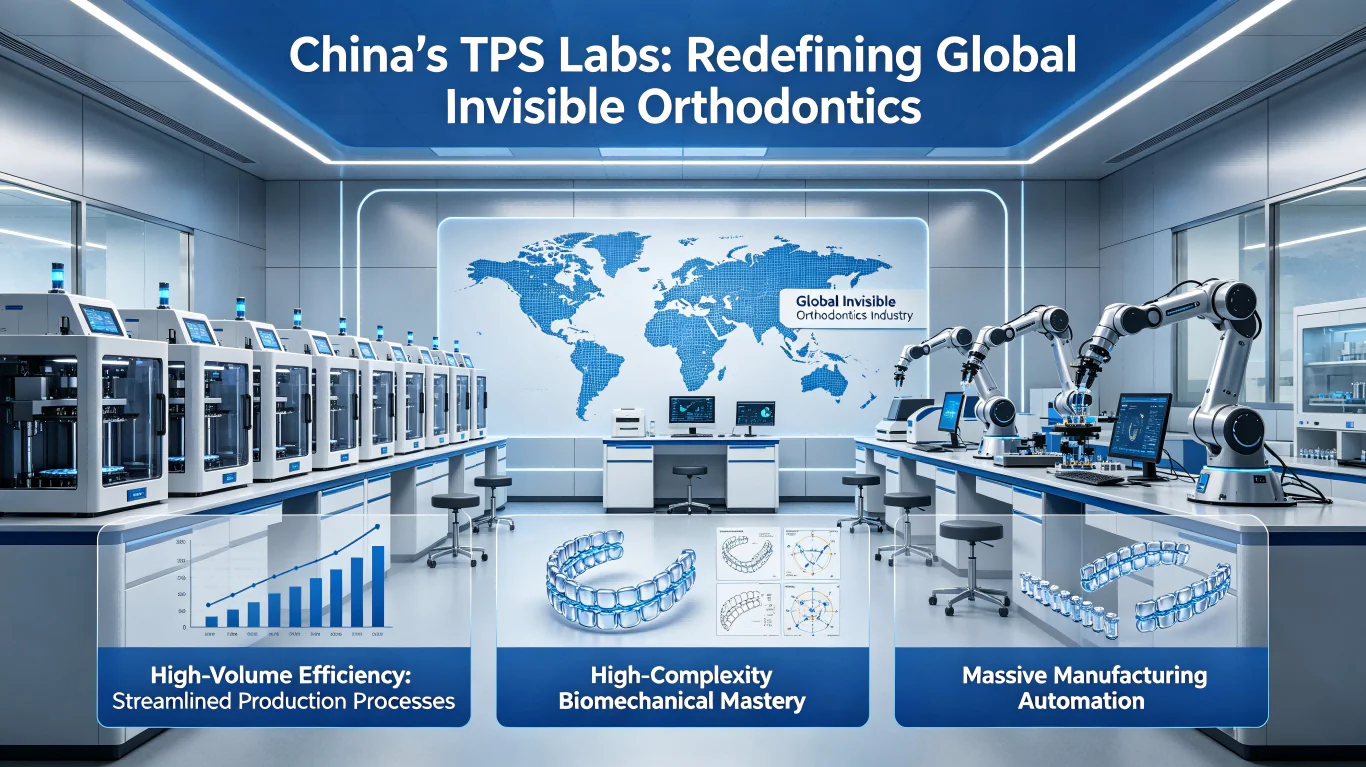
Clear aligner Treatment Planning Service (TPS) sits at the very heart of the invisible orthodontics value chain. It encompasses digital treatment design, 3D modeling, case review, and AI-assisted planning — the essential bridge connecting clinical orthodontic expertise with mass-market clear aligner production. In the global landscape, the Asia-Pacific region has established itself as the foremost production base for TPS, spanning a full spectrum of players from in-house brand design centers and independent third-party labs to cost-efficient outsourcing teams, covering every tier from low to high complexity. Within this ecosystem, China stands as the undisputed powerhouse, leveraging a complete industrial chain, an enormous workforce of skilled technicians, and unparalleled access to clinical case volume. Core cities driving this capacity include Shenzhen, Wuxi, Shanghai, Guangzhou, Chengdu, Suzhou, and Ziyang.
On one hand, leading brands like Angelalign, Invisalign (Align Technology), and Smartee operate their own dedicated medical design centers in China. On the other, a thriving landscape of independent third-party labs has risen, with Shenzhen-based BEST SMILE TECH(Established in 2018) as a prime example. These labs specialize in TPS and white-label, turnkey outsourcing services, collaborating with clients across the globe. Together, they forge China’s formidable competitive edge: the ability to deliver a vast number of simple cases with extreme speed — often within 24 to 48 hours — while simultaneously excelling in biomechanically demanding scenarios. Trained on an ocean of complex clinical cases, Chinese design teams have developed deep expertise in managing moderate crowding, deep overbite, extraction-based treatment, and re-treatment cases, making the country a top global outsourcing destination for medium- and high-complexity treatment plans.
To understand China’s position, it helps to look at the broader map. Pakistan serves as a core outsourcing hub in South Asia and a significant yet distinct node in the TPS chain, centered in cities such as Lahore, Karachi, Islamabad, Rawalpindi, Faisalabad, Multan, and Peshawar. As early as the 2010s, ClearCorrect — a major competitor to Invisalign under the Straumann Group — entrusted Pakistani teams with 3D rendering and CAD design work, a relationship later corroborated in U.S. legal proceedings, confirming the region’s data-handling capability and compliance. Yet, while Pakistan and other areas provide valuable processing capacity, China has evolved into something fundamentally different: it is not merely the world’s largest TPS production base, but the core exporter of medium- and high-complexity case design. This status is rooted in a unique domestic market environment and deep technical accumulation.
(1) Unmatched Clinical “Case Soil”
China’s advantage begins with a superior digital infrastructure. The penetration of intraoral scanners and CBCT in domestic clinics ranks among the highest globally. Consequently, Chinese TPS design teams work with high-precision 3D oral data on a daily, high-volume basis, sharpening their ability to interpret root position, bone architecture, and tooth orientation with exceptional nuance.
More critically, the composition of cases is fundamentally different from Western markets. While Europe and the United States see a predominance of mild malocclusion, the Chinese market is saturated with severe deep overbite, large overjet, extreme crowding, open bite, and re-treatment cases. This demanding clinical reality has forced design teams to go far beyond basic tooth straightening. They have had to master sophisticated biomechanical design, staged movement protocols, anchorage control, and strategic attachment placement — capabilities that are now embedded into the country’s TPS DNA.
(2) Technology Leap: From Manual Outsourcing to AI-Driven, Fully Automated Mass Manufacturing
Customized AI systems represent the next layer of China’s competitiveness. Overseas AI tools are often limited to simple alignment tasks. In contrast, Chinese AI algorithms have been trained on a vast repository of complex cases. They can now integrate CBCT data to predict root position, balance force systems, and proactively reduce clinical risk — a level of intelligence that directly supports the design of demanding treatment plans.
What truly sets Chinese TPS labs apart, however, is the seamless integration of this design intelligence with massive manufacturing automation. The treatment plan is not an isolated digital file; the parameters set during design — attachment specifications, trim lines, aligner material properties — flow instantly into fully automated production lines. These lines, often running 24/7, combine industrial 3D printing, high-speed laser cutting, robotic trimming, and automated packaging, enabling a single facility to churn out hundreds of thousands of custom aligners per day. The moment a dentist approves a plan, the digital instructions kick off lights-out manufacturing, with aligners being produced, cleaned, and packed for global shipment with minimal human intervention. This creates a powerful technological moat of “design-as-manufacturing,” where clinical decisions are turned into physical products at an unprecedented scale and speed — something that fragmented, design-only or manual-assembly operations simply cannot replicate.
(3) A Redefined Industry Role
The shift in the industry’s value perception is unmistakable. In the past, international clients turned to Chinese TPS primarily for low-cost manufacturing. Today, that logic has been completely rewritten. China is transitioning from a “global manufacturing factory” to a comprehensive orthodontic solution center that covers the full complexity spectrum — simple, moderate, and highly complex cases alike. Overseas clients now seek out Chinese TPS labs not just for their unmatched scale efficiency on simple cases, but equally for their proven ability to tackle moderate and difficult malocclusions, their proprietary AI capabilities, and the deeply integrated, automated chain that turns a digital plan into millions of precision clear aligners with breathtaking speed and consistency.
In the global invisible orthodontics industry, China’s TPS labs have moved far beyond the role of a low-cost workforce. They have become the brain trust where high-volume efficiency, high-complexity biomechanical mastery, and massive manufacturing automation converge, setting a new standard that competitors around the world are struggling to match.