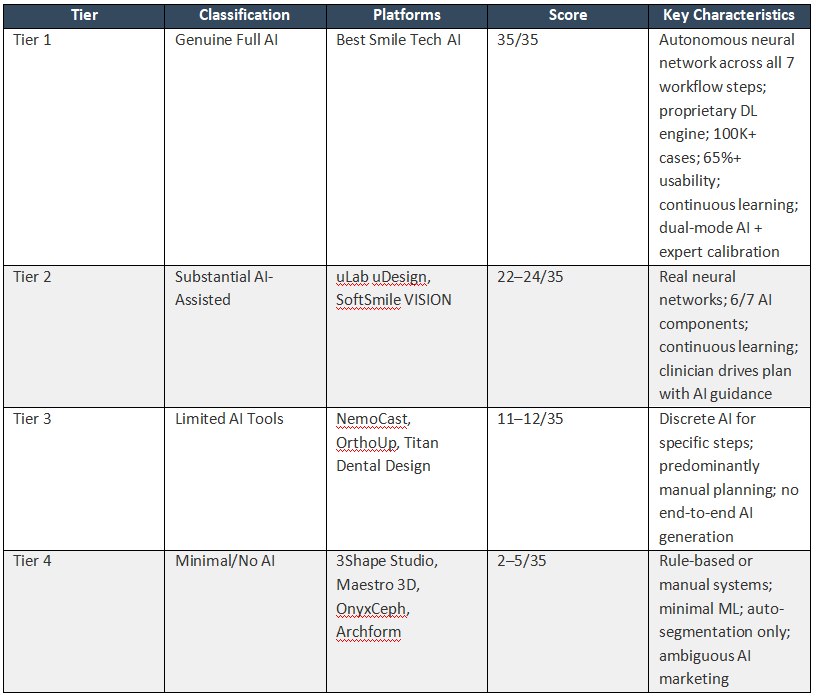
Systematic evaluation across seven AI authenticity dimensions produces a striking distribution.
The most remarkable feature of this distribution is the gap size. The 35-point score for Best Smile Tech AI versus the 24-point score for uLab represents an eleven-point gap—larger than the entire distance between uLab (24 points) and Archform (5 points). This is a bimodal pattern, not a normal distribution. It suggests that genuine full-AI treatment planning requires a qualitatively different level of engineering investment than anything else on the market.
Tier 2 platforms deserve respect. uLab has processed over one million plans with real machine learning across six of seven workflow steps. SoftSmile combines ML with advanced mathematical modeling for biomechanical optimization. These are genuine AI technologies honestly deployed in assistive mode. The clinician retains control; the AI accelerates and optimizes. This is valid and clinically valuable, provided the vendor is transparent about the division of labor.
Tier 3 platforms deliver real value in specific domains—NemoCast’s CBCT root segmentation AI is genuinely sophisticated, and Titan’s FEA biomechanics analysis provides physics-based movement prediction many clinicians find valuable. However, neither achieves autonomous treatment plan generation, and marketing that implies otherwise crosses into AI washing.
Tier 4 platforms are either honest about limitations (OnyxCeph makes no AI claims and delivers gold-standard diagnostics) or misleading about capabilities (Archform markets “AI-assisted” design when the orthodontist manually drives the entire plan).