
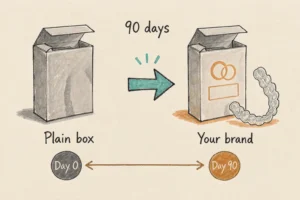
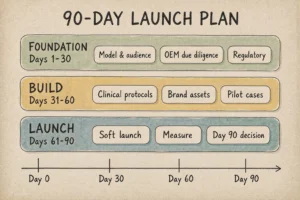
A white-label clear aligner brand — your name, your pricing, your patient relationship, built on a partner’s treatment planning and manufacturing — can realistically go from decision to first delivered case in 90 days. The structure mirrors what DSOs use for multi-location rollouts: Days 1–30 for foundation (business model, manufacturer due diligence, regulatory groundwork), Days 31–60 for build (clinical protocols, brand assets, systems, pilot cases), and Days 61–90 for launch (first cohort, measurement, playbook documentation). What you cannot compress is regulatory compliance: aligners are medical devices, and brands that “build the brand first and sort compliance later” pay for that ordering mistake expensively. What you absolutely should outsource at launch is planning and manufacturing (the two most expensive capabilities to build) while you invest in the thing that actually differentiates you: brand, clinical experience, and doctor relationships.
Why White-Label, and Why Now
Three market facts make this the right entry model in 2026:
The DTC-only model proved its limits. SmileDirectClub’s 2023 bankruptcy and the pivot of Candid and Byte toward hybrid, doctor-supervised care demonstrated that aligners sold as a pure consumer product face brutal marketing economics and regulatory scrutiny. The durable position in the value chain is the doctor-supervised brand, which is exactly what white-label enables.
DSOs are already doing it. Dental groups are increasingly sourcing aligners factory-direct and deploying them under their own group identity, capturing the brand premium that used to flow to national aligner companies. Groups running structured programs report orthodontic revenue growth of 30–50% within the first year across participating locations. The playbook exists and is proven; independent practices and new brands can run a lighter version of it.
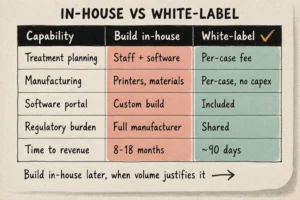
The economics are one-sided at launch. Compare the two paths for the capabilities that matter:
| Capability | Build in-house | White-label / outsource |
| Treatment planning | Staff + training + software + QC systems: high fixed cost | Per-case partner fee, near-zero fixed cost |
| Fertigung | Printers, thermoforming, materials, technicians, QMS: high capex | Per-case unit cost, no capex |
| Software portal | Custom build: slow and expensive | Included with the right manufacturing partner |
| Regulatory burden | Full manufacturer obligations | Shared: your partner carries manufacturing compliance; you carry market-facing obligations |
| Time to first revenue | 8–18 months | ~90 days |
Build in-house later, when volume justifies it. At launch, capital belongs in brand and growth — the assets your partner can’t give you.
The 90-Day Plan
Phase 1: Foundation (Days 1–30)
Week 1 — Choose your model and audience precisely. Doctor-supervised white-label (recommended) vs. DTC (avoid as a first venture). Then narrow your audience: “general dentists in the Gulf region new to aligners” is winnable; “everyone” is not. Specificity is a competitive advantage when you’re early.
Weeks 2–3 — Manufacturer due diligence. This is the decision everything else rests on. Send your prospective partner one real moderate-to-complex case and judge their planning quality, turnaround against their claimed SLA, and revision handling. Evaluate at least two manufacturers head-to-head.
Weeks 3–4 — Regulatory groundwork, in parallel. Aligners are medical devices in every major market: FDA in the US, EU MDR with ISO 13485 in Europe, plus country-level registration elsewhere. Budget for proper regulatory advice now, not after launch. Clarify with your manufacturer exactly which obligations they carry (manufacturing compliance, device documentation) and which you carry (market registration, labeling, post-market responsibilities in your jurisdiction).
Week 4 — Commercial agreement. Per-case pricing at your realistic volume tier, refinement and remake policy in writing (remember: [70% of cases will need at least one], SLA remedies, white-label rights covering packaging through the case portal.
Phase 2: Build (Days 31–60)
Weeks 5–6 — Clinical protocols. With your manufacturer’s clinical team, define: case eligibility criteria (what you’ll accept at launch — start mild-to-moderate), scanning standards, submission workflow, setup-review procedure, and the refinement pathway. Document it. This protocol document, not your logo, is the foundation of every clinical outcome your brand will produce.
Weeks 5–7 — Brand and experience assets. Name, visual identity, packaging design, patient instructions, and the doctor-facing experience: a clean ordering workflow, clear case communication, and a portal that carries your name. Experience is part of the product, and it’s one of the few areas where a focused new brand can genuinely outmaneuver slow incumbents.
Weeks 7–8 — Systems and training. Connect scanners to the case portal; make aligner cases a distinct revenue line in your practice management or accounting system; train everyone who touches a patient on consultation scripting and case identification. In DSO rollouts, team training is consistently the single biggest driver of first-year case volume — the same is true for a single-location brand.
Week 8 — Pilot cases. Run 3–5 real cases end-to-end before any public launch: scan → plan → review → manufacture → ship → deliver. Time every step. Fix every friction point now, while the stakes are invisible.
Phase 3: Launch (Days 61–90)
Weeks 9–10 — Soft launch to your first cohort. If you’re a practice or small group: your existing patient base and a waiting-room smile survey are the highest-converting launch channel that exists. If you’re a new B2B brand: a small cohort of friendly doctors with a low-friction, discounted first case. Remove every unnecessary step from the initial submission — approval should feel effortless.
Weeks 10–12 — Measure and document the playbook. Track: case acceptance rate, average fee, turnaround at each stage, patient satisfaction, refinement requests. Everything you learn goes into an operational playbook — the document that lets you scale to a second location or a second cohort of doctors in 30 days instead of 90.
Day 90 — Decision point. Scale what worked (more locations, more doctors, more marketing), fix what didn’t (usually consultation conversion or workflow friction), and revisit the in-house question only when monthly volume gives you real data.
What It Costs: A Realistic Budget
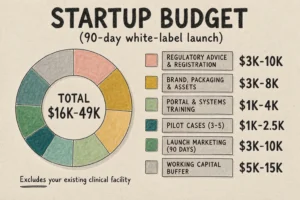
For a white-label launch (excluding your clinical facility, which you already have):
| Artikel | Realistic range |
| Regulatory advice & registration | $3,000–10,000 (market-dependent) |
| Brand identity + packaging + materials | $3,000–8,000 |
| Portal/systems setup & training | $1,000–4,000 |
| Pilot cases (3–5) | $1,000–2,500 |
| Launch marketing (initial 90 days) | $3,000–10,000 |
| Working capital buffer | $5,000–15,000 |
| Total launch budget | $16,000–49,000 |
Compare: building planning + manufacturing in-house starts in the hundreds of thousands and pushes first revenue past a year. Against per-case OEM costs of $500–1000 and typical patient fees of $2,000–5,500, a white-label program reaches break-even at roughly 10–20 completed cases: which is why this model, executed with discipline, is one of the highest-ROI service launches available to a dental organization.
The Five Mistakes That Kill New Aligner Brands
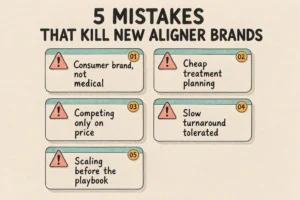
- Treating it as a consumer brand instead of a medical one.Compliance and clinical quality come first. Regulatory issues discovered after launch cost multiples of the advice you skipped before it.
- Underinvesting in treatment planning.Planning quality is the foundation of every outcome and every referral. A beautiful brand cannot survive consistently poor setups; excellent planning with modest branding can. This is why the trial case matters more than the logo.
- Competing only on price.Doctors stay for reliability, clinical results, and support. Price gets them in the door; quality keeps them. A race to the lowest price has no good finish line.
- Tolerating slow or unreliable turnaround.Doctors leave over slow delivery long before they leave over price. Treat your manufacturer’s SLA performance as a core brand feature, because your patients will experience it as one.
- Scaling before the playbook exists.The 90 days buy you a provensingle-unit operation. Scaling an unproven one just multiplies its problems.
Häufig gestellte Fragen
What is a white-label clear aligner program?
A certified OEM manufacturer produces aligners (and often provides treatment planning) that you sell under your own brand: your name on the packaging, the cloud portal, and the patient relationship. You own the customer experience and pricing; the partner carries the manufacturing and (depending on the arrangement) the planning infrastructure, some oem manufacturers like Best Smile Tech provides both design and manufacturing capability, as well as the cloud platform, some oem aligner manufacturers doesn’t have deisgn capability and cloud platform.
How much does it cost to launch a white-label aligner brand?
A realistic 90-day launch budget runs $16,000–49,000 covering regulatory work, branding, systems, pilot cases, and initial marketing — versus hundreds of thousands and 8–18 months to build planning and manufacturing in-house. With OEM costs of $500–1000 per case against $2,000–5,500 patient fees, break-even typically arrives at 10–20 completed cases.
Do I need my own FDA clearance or CE marking to sell white-label aligners?
Regulatory responsibilities are shared. The manufacturer carries manufacturing-side compliance and device documentation; you typically carry market-facing obligations (registration, labeling, and post-market duties in your jurisdiction) which vary significantly by country. Get proper regulatory advice before launch; this is not the place to improvise.
White-label vs. building my own manufacturing, which is right?
White-label at launch, almost universally. The two most expensive capabilities (clinical planning and manufacturing) are exactly the ones a partner can provide on a per-case basis with no capex. Revisit in-house production only when volume and margin data justify it, typically well past the first year.
How do DSOs structure white-label rollouts across locations?
A phased approach: manufacturing agreement and pricing first, then clinical protocols, systems integration, team training, and a pilot cohort of 3–5 locations. Industry benchmarks put the first cohort at 60–90 days, with subsequent cohorts onboarding in 30 days or less once the playbook is proven.
What makes doctors choose one white-label brand over another?
Turnaround reliability, planning quality, and support — in that order, ahead of price. In a clinical market, trust beats hype: one credible early case and a responsive clinical team generate more referrals than any campaign. Doctors talk to each other.
Best Smile Tech runs white-label programs end-to-end: your brand on the box and the cloud portal, AI-plus-expert planning with a 48-hour SLA, fast manufacturing and DDP worldwide shipping, and free training for your team. Start with one free trial case design and judge our planning quality before anything else — [bestsmiletech.com](https://www.bestsmiletech.com).


