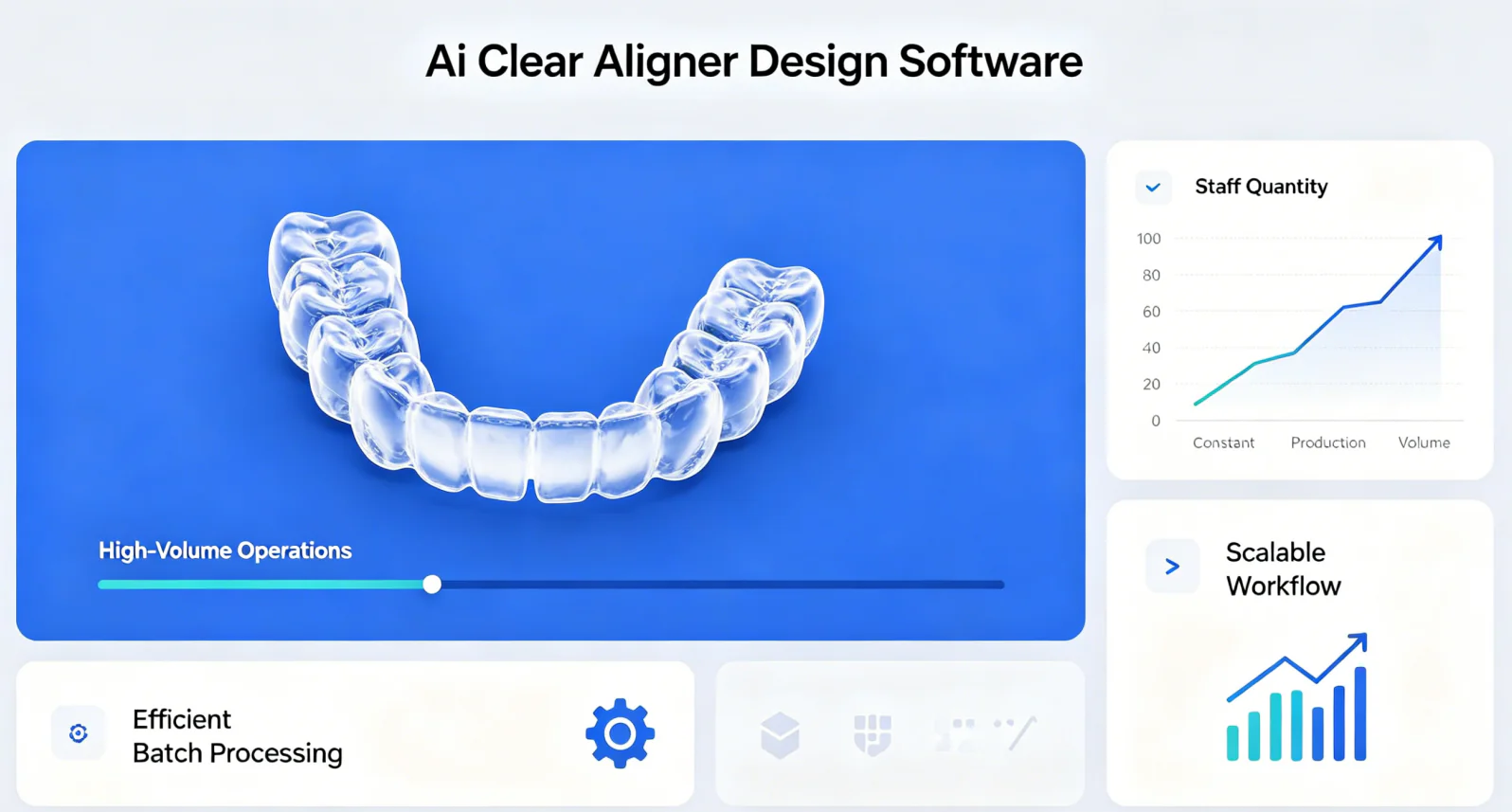
The third promise is scalability.
A laboratory on manual planning faces a linear relationship between case volume and staffing. One thousand cases per month requires roughly thirty-five technicians. Five thousand cases demands a proportional increase. This linear scaling creates operational fragility: hiring delays, training periods, turnover recovery, and quality dilution.
AI-generated planning breaks this relationship. A single quality-control technician can review approximately forty-eight AI-generated plans per eight-hour day, compared with four to six manually built plans. At five thousand cases per month, staffing drops from roughly forty full-time technicians to approximately five. Annual labor cost savings range from $1.5 million to $2.5 million for a high-volume laboratory.
This scalability also enables practice models that were previously impractical. A chairside practice offering same-day aligner starts cannot do so if planning takes two hours. A ten-minute AI-generated plan allows the patient to see their complete 3D treatment simulation and walk out with printed aligners in a single appointment. Case acceptance data suggest this immediacy increases conversion rates by 30% to 50%.