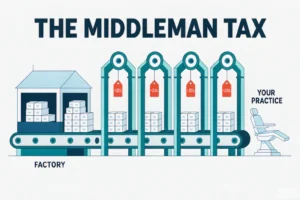
The direct answer: Between an aligner factory and your chair, every intermediary layer adds roughly 15–40% to the price you pay. Industry markup data shows manufacturers typically add 15–20% when selling to distributors, distributors add another 20–40%, and dental-supply distributor markups average around 20% but range from 5% to 40% depending on product and market. Stack two or three layers and a case that leaves a factory at $300 reaches your practice at $500–800 — without a single additional aligner being made. But the middleman tax isn’t always waste: distributors earn their margin when they provide local inventory, clinical support, regulatory handling, and consolidated logistics. The question isn’t “middleman or not” — it’s whether each layer in your supply chain is doing work you’d otherwise have to do yourself.
How the Layers Stack Up
Follow a aligner case from factory floor to practice shelf:
| Stage | Typical markup | What happens |
| Factory production cost | — | Design, printing, thermoforming, trimming, QA |
| Factory → export/trading company | 15–25% | Export documentation, international sales |
| Exporter → national distributor | 20–40% | Import, regulatory registration, warehousing |
| Distributor → regional reseller/agent | 10–30% | Local sales force, rep visits |
| Reseller → your practice | 10–20% | Final-mile service, payment terms |
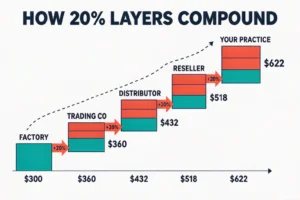
Not every chain has all four layers, but many do, especially for Asian-manufactured aligners reaching the US or Europe through legacy channel structures. Compounding is brutal: four modest 20% layers multiply a $300 factory cost into $622. You’re not paying 80% more; you’re paying 107% more, because each layer marks up the previous layer’s margin.
What Each Layer Is Supposed to Do
Fairness requires stating what intermediaries actually contribute when they contribute:
Regulatory navigation. Importing a medical device into the US or EU means FDA listing or MDR compliance, registration fees, and liability exposure. A distributor who handles this provides real value — particularly for practices that can’t or won’t manage import compliance themselves.
Local inventory and speed. A domestic warehouse means two-day shipping instead of two-week international freight. For a practice that promised a patient their next tray on Thursday, that’s worth money.
Clinical and technical support. A local rep who troubleshoots a tracking issue chairside, trains your staff, and speaks your language in your time zone is a genuine service layer.
Consolidated procurement. One vendor relationship, one invoice, one credit line across dozens of manufacturers — administrative simplification with real salary-cost value, as procurement research consistently shows.
Financing and payment terms. Net-30 or net-60 terms are working capital. Factories selling direct often want payment before production.
When your distributor does these things, their 20% isn’t a tax — it’s a service fee. The tax begins when they do none of them.
The Pure Middleman: Recognizing the Tax
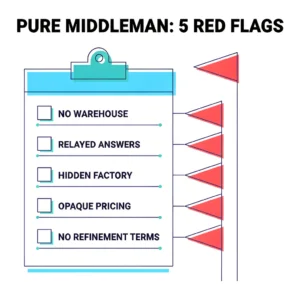
The costly intermediary is the order-passer: no warehouse, no regulatory role, no clinical support, no inventory risk — just a forwarded email and an invoice with margin attached. Warning signs:
- Your “local vendor” ships directly from an overseas factoryto you, with 2–3 weeks lead time. They’re a mailbox, not a warehouse.
- Technical questions get relayed, not answered.If every clinical query takes 48 hours because it’s being translated and forwarded, you’re paying for a middleman and doing the waiting yourself.
- They can’t tell you the factory’s name.Legitimate distributors know their manufacturers; order-passers hide them because your finding the factory is their existential threat.
- Pricing is opaque and “per quote.”Layers survive on information asymmetry. Transparent per-case price lists threaten them.
- No refinement policy in writing.Pure resellers often can’t commit to refinement terms because they don’t control the factory’s schedule.
Each of these is margin without service — the purest form of the tax.
The Honest Counterargument: When Cutting the Middleman Costs You More
Procurement research on direct-vs-distributor economics makes a point every factory-direct evangelist should concede: the invoice price is not the total cost. Buying direct raises your internal burden in specific ways:
- Vendor management overhead.Every direct factory relationship means onboarding, contracts, quality audits, and cross-timezone communication — real salary cost that hides off the P&L line.
- Minimum order quantities.Factories optimize for production runs; a practice ordering 20 cases a month may not clear MOQs that a distributor aggregates across hundreds of customers.
- Import complexity.Customs documentation, device registration, and duty handling become your
- Risk concentration.No local buffer stock means a shipping delay is your delay, with patients waiting.
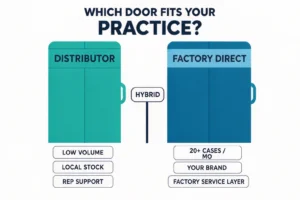
The math flips in favor of factory-direct when your volume is meaningful (roughly 20+ aligner cases monthly), when the factory itself provides the service layer (design support, English-speaking clinical team, DDP shipping that handles customs), or when you’re building a private-label brand where channel margin directly competes with your own.
The 2026 Shift: Factories Are Becoming Service Companies
The reason this conversation is happening now is that the old division of labor is collapsing. Modern OEM manufacturers increasingly absorb what distributors used to monopolize:
- Cloud design platformsreplace the distributor’s “clinical liaison” — your case is reviewed by the factory’s own technicians, with 48-hour SLAs.
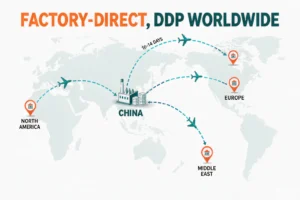
- DDP (Delivered Duty Paid) logisticsputs customs and duties on the factory, making international shipping feel domestic.
- Multilingual support teamsin overlapping time zones answer clinical questions directly — no relay, no 48-hour translation lag.
- Per-case ordering with no MOQremoves the aggregation argument for low-volume practices.
When the factory provides the service layer, the distributor’s remaining function is a local address, and 20–40% is a lot to pay for an address.
A Decision Framework for Your Practice
Stay with your distributor if: your volume is low and sporadic; you genuinely use their local inventory and same-week delivery; their reps provide real clinical support; or import compliance is something you cannot take on. Their margin is earned.
Go factory-direct if: you run 20+ cases monthly; you want your own brand on the box; your distributor fails two or more of the “pure middleman” tests above; or the factory offers a service layer (design review, DDP shipping, direct clinical support) that duplicates what you were paying the channel for.
Hybrid — the sophisticated middle: keep a domestic distributor for urgent-fill and commodity supplies where two-day availability matters, and route your planned aligner production factory-direct where lead times are scheduled anyway. Most practices overestimate how much of their purchasing is truly urgent.
Preguntas frecuentes
How much do dental distributors typically mark up products?
Industry data puts dental supply distributor markups at an average of about 20%, ranging from 5% to 40% depending on product and market. Across the broader supply chain, manufacturers add 15–20% selling to distributors, and distributors add 20–40% reselling, which compounds in multi-layer chains.
Are overseas aligner factories reliable enough to buy from directly?
The legitimate concern is recourse: what happens when something goes wrong? Evaluate a direct factory the way you’d evaluate any vendor — years in operation, case volume, references in your market, written SLAs, and whether they carry regulatory registrations for your country. A factory with 100,000+ completed cases and English-speaking clinical staff is a different risk profile from an anonymous trading company.
What’s the difference between a distributor and a trading company?
A distributor typically holds inventory, handles regulatory registration, and provides local support — services that justify margin. A trading company brokers transactions without holding stock or adding service; in aligners, trading companies are the most common source of the pure middleman tax.
Will going factory-direct hurt my relationship with local reps?
Only if your volume with them was significant, and even then, hybrid models preserve the relationship for product categories where their service genuinely matters. Most reps respect a practice that can articulate exactly which value it is and isn’t paying for.
How do I verify whether my current vendor is a manufacturer or a reseller?
Ask three questions: What’s your factory’s name and location? Can I audit or video-tour the production facility? Do you hold the device registration in your own name or the factory’s? Resellers stumble on at least one.
Does factory-direct mean longer lead times?
Not necessarily. A factory running DDP air freight with a 48-hour design SLA typically delivers finished aligners in 10–14 days door-to-door — comparable to a domestic distributor’s turnaround for anything not sitting in local stock, and faster than a reseller who relays your order onward.