Should a dental group run clear aligners through a brand-name partner, an in-house lab, or an OEM manufacturer? Check this article and compare dso clear aligner program economics, and verify before you sign.
Why this decision matters now
Dental service organizations employ more than 100,000 dentists across 8,000+ US clinics, and affiliation among recent graduates has passed 25% (ADA, 2025). The engine that built most DSOs has slowed, however. With financing costs elevated, deal volume has fallen to historic lows, and operators are refocusing on same-store growth (Group Dentistry Now, November 2025).
Few service lines serve that agenda as well as clear aligners. They carry high margins, take little chair time, sit comfortably in general dentist hands, and are demanded by the two fastest-growing patient segments in orthodontics: adults and teens. The question for a DSO is no longer whether to run an aligner program. It is how to source one. The three realistic routes are a brand-name partner, an in-house lab, or an OEM manufacturer. They differ by several hundred dollars per case, and at group scale that spread is worth millions a year.
Why aligners fit the DSO operating model
Demand is proven at scale. Align Technology shipped a record 2.61 million cases in FY2025 and another 685,700 in Q1 2026, with growth in both channels: +5.3% among general dentists and +8.9% among orthodontists (Align Technology Q4 2025 and Q1 2026 results).
Growth sits where DSOs already operate. Adults drive 85.4% of aligner revenue, and 935,800 teenagers started Invisalign treatment in 2025 (Grand View Research; Align FY2025). Both segments walk into the group’s existing GP network.
Aligners run on the workflow pattern DSOs are built to scale. Intraoral scanning, cloud case management, and centralized treatment planning are standardized digital processes, and DSO market reports already rank digital workflow standardization among the top value-creation initiatives (Precedence Research, 2026).
Suppliers are courting you. Align’s CEO cited “strong progress with DSOs across all major regions” on the Q4 2025 earnings call. When the incumbent competes for your volume, you negotiate from strength.
The three supply models
Each model is defined by who owns two things: production, and the patient-facing brand.
Model 1: Brand-name partner — rent the brand
Your clinics prescribe an established brand such as Invisalign, Spark, or ClearCorrect. The supplier handles design, manufacturing, and the patient-facing brand. The DSO supplies patients, clinicians, and chair time.
Economics. A full comprehensive course typically carries published lab fees of $1,700–$1,900 per case. Align’s reported revenue per case averaged about $1,245 across 2025–Q1 2026 , a blended figure across tiers and products, so price your actual case mix rather than assume the average. Against typical patient fees of $4,500–$6,000, each case still leaves a healthy practice margin. What it does not leave the DSO is a share of the manufacturing spread or any brand equity. Renewal pricing, tier changes, and refinement policy stay with the supplier.
Best for. Groups under roughly 20 locations, or any group treating this as a transition state while a proprietary program is built.
Model 2: In-house production — own the factory
The group buys scanners, 3D printers, thermoformers, and design software; hires designers and technicians; and produces aligners in a central lab or across locations. It owns the process end to end, including its risks.
Economics. Planning software runs about €3,000 per seat per year. Each case consumes 1.5–2 hours of skilled design time, or $225–$300 at typical loaded rates. Materials and fabrication add $15–$25 per aligner, in line with published self-production costs such as eXceed’s $18–$21 per unit. At steady state, a well-run in-house case lands at $500–$900, and only after the capital expenditure, hiring, training, and quality systems are in place. That fixed-cost tail is where budgets break: groups that operate labs recommend planning for roughly twice the first estimate.
Best for. Very large groups (100+ locations) with real lab culture and the patience to build manufacturing competence over 12–24 months. The real gate is case density and design talent, not location count alone.
Model 3: Outsourced OEM partner — rent the factory, keep the brand
An OEM partner performs treatment planning, manufacturing, and packaging to the DSO’s brand and quality bar. The DSO keeps the patient relationship, the brand, and the margin stack without buying a printer or building a design team.
Economics. Outsourced treatment planning is priced from about $35 to $280 per case depending on depth, from design-only uploads to orthodontist-reviewed plans (published 2026 service rates). OEM production then bundles design, manufacturing, and custom packaging into a single per-case fee that, in the scenario below, lands 40–60% below brand-name lab fees. 3Shape open-workflow users already report delivering cases €500–€1,000 cheaper than name-brand equivalents through the same unbundled route (OrthoPractice US).
Best for. Groups from about 20 up to several hundred locations that want proprietary economics and brand equity without owning a factory.
Per-case economics at a glance
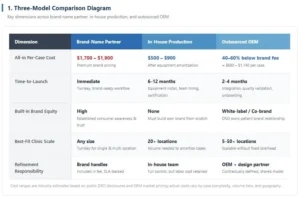
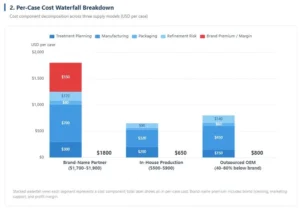
| Cost component | Brand-name partner | In-house production | Outsourced OEM |
| Treatment planning | Bundled into lab fee | $225–$300 labor per case + ~€3,000/yr per seat | $35–$280 published, or bundled |
| Produzione | Bundled into lab fee | $15–$25 per aligner + equipment capex | Bundled into per-case fee |
| Packaging and branding | Supplier’s brand | Self-managed | Your brand, custom packaging |
| Typical all-in cost per case | $1,700–$1,900 | $500–$900 at steady state, after capex | 40–60% below brand-name fees (scenario) |
| Refinement exposure | Supplier’s policy | Fully self-funded | Negotiable SLA |
| Time to launch | Immediate | 12–24 months | 3–6 months |
| Brand equity built | None — accrues to the supplier | Yours | Yours |
Figures in USD unless noted; € values reflect published European list prices. In-house totals assume design labor, materials, and allocated capital. The OEM 40–60% range is a scenario based on the assumptions in the next section, not a market-wide guarantee.
What the choice looks like at 50 locations
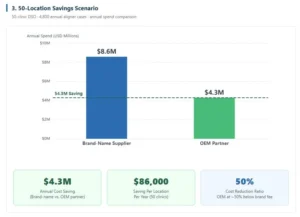
Take a 50-location group averaging eight aligner cases per location per month: 4,800 cases a year.
Brand-name route. At a $1,800 average lab fee, 4,800 cases cost about $8.6 million paid to the supplier each year.
OEM route. At a 50% reduction, the same case volume costs about $4.3 million. That is an annual swing of $4.3 million, or roughly $86,000 per location, before counting the enterprise value of an owned aligner brand.
In-house route. Steady-state unit cost can be lower still, but only after an estimated $1–2 million in capex and 12–24 months of ramp. That payback profile is why many groups that start down this path return to an outsourced model within two years.
Adjust the fee or the case volume and the direction holds. The spread between models is a budget line, not a rounding error. And because the saving scales with volume rather than location count, a 20-location group running dense volumes can beat the model math of a lighter 50-location group.
The metric that decides program success: throughput, not volume
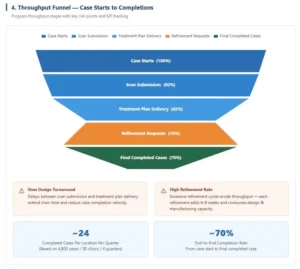
Case starts measure activity. Throughput measures results. Define throughput as cases completed on the original treatment plan, per location, per quarter. It falls when plans return slowly, when refinements accumulate, and when clinicians lose confidence in the setups they approve. Unit price is the visible cost; throughput is where the program actually wins or loses money.
That makes three supplier capabilities more important than unit price:
Design turnaround. A committed 48-hour plan review keeps the patient engaged. A seven-to-ten-day queue moves the family toward the braces conversation instead.
First-time-right design. Every refinement costs a rescan, a new set of trays, chair time, and patient trust. Plan quality is the largest controllable driver of the refinement rate, which makes it a cost line rather than a service feature.
Multi-location case visibility. Clinical directors need one cloud console to audit every plan across every location, not a per-doctor inbox with email threads.
Eight checks before you commit
Whichever model you choose, verify these eight points with a trial case and reference calls:
- Design turnaround committed in writing, in hours rather than “business days TBD.”
- Orthodontist review on every plan, with a named reviewer.
- Complex-case capability. Ask for the provider’s moderate-to-complex case ratio, not a demo reel.
- Cloud case management spanning all locations and doctors.
- White-label packaging and patient materials under your brand.
- Refinement policy: cost, turnaround, and who decides.
- Data security: HIPAA/GDPR posture for patient records.
- GP training program. Aligner programs fail on clinician confidence before they fail on supply.
A decision framework by group size
The thresholds below are proxies for what actually matters: annual case volume and the group’s appetite for a 12–24 month capability build. If you sit between two tiers, run the numbers rather than follow the rule.
Under ~20 locations. Stay with a brand-name partner, but negotiate volume tiers and start tracking lab fees as a percentage of production. That ratio tells you when the model stops being the cheap option.
~20–50 locations. Pilot an OEM program in 5–10 flagship locations, ideally with one free trial case per site. Run brand and OEM side by side for two quarters, then compare throughput and margin per completed case before deciding whether to scale.
~50–200 locations. Move to OEM as the primary model and put a clinical director in charge of plan quality. Groups above roughly 100 locations with genuine lab talent may justify earlier in-house investment (see Model 2); everyone else should add in-house capability only where same-day needs pay for the equipment.
200+ locations. Use OEM for volume and build in-house capacity only in regions with enough case flow to amortize it. At this scale, owning the brand is worth more than owning the machines.
Frequently asked questions
How much can a DSO save by moving from brand-name aligners to an OEM partner?
The scenario math in this guide puts OEM per-case cost 40–60% below brand-name lab fees. For a 50-location group running 4,800 cases a year at $1,700–$1,900 fees, that is roughly $4 million annually at the midpoint. Actual savings vary with case mix and service level, so test with a trial case before extrapolating.
Should a DSO build its own aligner lab?
Only at very large scale with genuine lab expertise. Software (~€3,000/year per seat), 1.5–2 hours of design labor per case, equipment capex, and quality systems mean in-house production typically needs 100+ locations and 12–24 months to pay back. Most mid-size groups get better risk-adjusted returns from an OEM partner.
What is the most common reason DSO aligner programs underperform?
Slow, inconsistent treatment planning. When clinicians wait seven to ten days for a setup, case acceptance drops and refinements rise. A guaranteed 48-hour turnaround on orthodontist-reviewed plans is the single highest-leverage fix.
Can a DSO white-label aligners under its own brand?
Yes. OEM partners manufacture, package, and ship aligners under the DSO’s brand, including custom cases, inserts, and patient materials. Patients see your brand; the factory stays invisible.
How do you keep clinical output consistent across dozens of locations?
Centralize treatment planning under one design standard and one review process, and give clinical directors cloud visibility into every case. Consistency is a systems problem, not a hiring problem.
What should a DSO ask an OEM partner before signing?
Turnaround SLA, orthodontist review process, complex-case track record, multi-location platform, refinement policy, white-label scope, and data security posture. Then run one free trial case to verify all of it with real work.
About the La migliore tecnologia del sorriso
Best Smile Tech has been China’s pioneering OEM clear aligner manufacturer since 2018. We provide full-stack aligner capabilities: AI-assisted aligner design software, a cloud case-management platform, treatment planning services, OEM aligner production, in-house clear aligner production solution, and professional design training. Try one free trial case to see how the workflow performs on your own case type.