
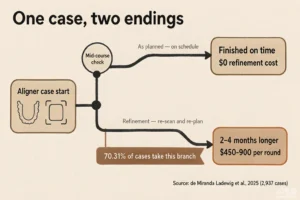
The most rigorous recent data puts the clear aligner refinement rate at 70.31% — a 2025 peer-reviewed survey of 188 orthodontists covering 2,937 completed cases found that seven in ten cases needed at least one round of additional aligners, and 21.95% needed two or more. Earlier research is even starker: only 6% of Invisalign patients historically finished without any refinement, averaging 2–3 refinement rounds and 22.8 months of treatment. For a practice running 200 aligner cases a year, a 70% refinement rate means roughly 140 unplanned re-planning cycles annually — about 280 hours of unbillable clinical and administrative time, plus direct lab costs of $35,000–56,000 if refinements aren’t included in your vendor plan. Refinements are not a failure of the technique; they are a structural feature of it. But their cost to your practice is a choice, determined by your planning quality, your lab partner, and your vendor contract.
The Data: What Studies Actually Show
| Finding | Figure | Source |
| Cases needing ≥1 refinement | 70.31% | de Miranda Ladewig et al., 2025 survey of 188 orthodontists (2,937 cases) |
| Cases needing ≥2 refinements | 21.95% | Same study |
| Patients finishing with zero refinements | 6% | Kravitz et al., classic prospective Invisalign data |
| Average refinements per patient | 2–3 rounds | Kravitz et al.; corroborated by retrospective reviews (~2.4 scans/patient) |
| Broader reported range | 33–80% depending on era and case mix | Systematic reviews; rates fell with better materials and attachments |
| Tooth-movement accuracy per phase | ~41% (2009) → ~50% (2020) → ~59% | Kravitz; Haouili; Simon et al. |
Two findings deserve special attention because they overturn common assumptions.
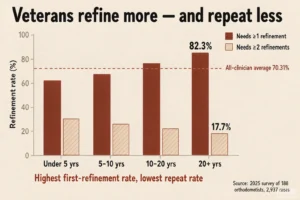
Experienced clinicians refine MORE, not less. The 2025 study found orthodontists with 20+ years of experience requested refinements in 82.3% of cases (the highest of any group) but had the lowest rate of second refinements (17.7%). Interpretation: experts take harder cases and hold higher finishing standards, but their refinements are surgical and final. Inexperience shows up not as more first refinements but as more repeat refinements.
Refinements don’t fix everything. A 2025 Journal of Dentistry study on deep overbite correction found first-phase aligners achieved 45.54% of planned intrusion, but the second phase added just 0.29% accuracy and the third 3.54%. If the biomechanics of the original plan were wrong, printing more trays of the same plan changes nothing. The refinement that works is a redesign, not a reprint.
The True Cost Stack of One Refinement
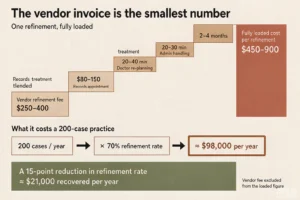
When a case comes back for refinement, the invoice from your aligner vendor is the smallest number involved. The full stack:
| Cost component | Typical value |
| Vendor refinement fee (if not included) | $250–400 per round; $500–2,000 on limited tiers |
| Records appointment (scan, photos, review) | 30–45 min chair time ≈ $80–150 at standard overhead rates |
| Doctor re-planning and setup review | 20–40 min of doctor time |
| Administrative handling (submission, tracking, patient communication) | 20–30 min staff time |
| Extended treatment duration | 2–4 months of additional patient management |
| Patient-experience cost | Delayed finish → review/referral impact (unquantifiable but real) |
| Fully loaded cost per refinement | $450–900, excluding the vendor fee |
Run the practice-level math: 200 cases/year × 70% refinement rate × $700 average loaded cost = $98,000 per year absorbed by refinements. A 15-point reduction in refinement rate recovers roughly $21,000 annually — before counting freed chair time. This is why refinement economics, not lab sticker price, is the right lens for comparing aligner vendors (see our full [lab fee breakdown](/blog/clear-aligner-lab-fees-explained/)).
Why Refinements Happen: The Preventable vs. the Inevitable
Root-cause analyses from high-volume labs consistently cluster refinement triggers into four buckets:
Planning errors (largest preventable share). Staging that violates expression limits — more than ~0.25 mm linear movement or 2–3° of rotation per tray; asking canines to rotate without adequate attachment design; sequencing everything at once instead of leveling first, then space management, then finishing. Software permits these plans; biology rejects them.
Diagnostic gaps. Scans with missing distal molars, absent bite registration, no CBCT on expansion or perio-risk cases. The software extrapolates; extrapolation drifts; drift becomes refinement at tray twelve.
Compliance reality. Plans engineered for exactly 22 hours of daily wear under-track on patients averaging 18–20. Conservative staging with targeted overcorrection (20–30% on movements that predictably under-express, like round-rooted tooth rotations and extrusions) absorbs normal human behavior.
Genuine biological variability. Ankylosed teeth, dense bone, unpredictable perio response. Real, but a smaller share than most clinicians assume, and notably, this is the only bucket that better software or a better lab cannot fix.
The implication is uncomfortable but empowering: the majority of refinements are designed into the case on day one. Which means the majority can be designed out.
The Movement Limits That Predict Trouble
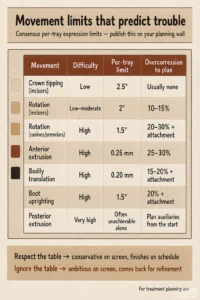
Publish this table on your treatment-planning wall. It consolidates consensus per-tray expression limits with the overcorrection that experienced planners build in:
| Movement | Difficulty | Per-tray limit | Overcorrection to plan |
| Crown tipping (incisors) | Basso | 2.5° | Usually none |
| Rotation (incisors) | Low–moderate | 2° | 10–15% |
| Rotation (canines/premolars) | Alto | 1.5° | 20–30% + attachment |
| Anterior extrusion | Alto | 0.25 mm | 25–30% |
| Bodily translation | Alto | 0.20 mm | 15–20% + attachment |
| Root uprighting | Alto | 1.5° | 20% + attachment |
| Posterior extrusion | Very high | Often unachievable alone | Plan auxiliaries from the start |
A plan that respects this table reads conservative on screen and finishes on schedule. A plan that ignores it reads ambitious on screen and comes back for refinement.
Reducing Your Rate: The Practice Protocol
Practices with refinement rates well below the 70% industry figure share a systematic workflow. The highest-leverage elements, in order of impact:
- Structured setup review before approval.Treat the first staging the software produces as a draft, never a deliverable. one or two revision rounds add 3–5 days at the start and remove 4–8 weeks at the back end. If your current process is “approve and print,” this is your biggest single fix.
- Re-scan discipline.Any scan with capture defects goes back to the chair immediately, patching in software introduces error exactly where it matters most. This one rule visibly drops refinement rates within a quarter.
- The tray-4-to-6 checkpoint.Tracking loss is visible by the fourth to sixth tray. A structured review at that window (in-office or via photo-based remote monitoring) catches deviations when a recovery sequence of a few trays can still fix them, instead of a 20-tray full refinement.
- Recovery before refinement.Always ask first: “Can this be recovered without a new scan?” Extending wear, adding a chairside button, or a short recovery series resolves a surprising share of tracking issues.
- A lab partner that pushes back.The single strongest external predictor of low refinement rates is whether your lab employs clinical reviewers who will flag over-ambitious staging before manufacturing. A lab that prints whatever you submit is a fulfillment center; a lab that says “this canine rotation will under-express” is a clinical partner.
The Contract Question: Who Pays for the 70%?
Even a well-run practice will refine 30–50% of cases. What that costs depends entirely on paperwork signed before the first scan:
- Unlimited-refinement tiers(e.g., Invisalign Comprehensive, typically 5-year windows) convert refinement risk into a fixed cost — priced into a higher case fee.
- Per-round charges($250–400) make every refinement a fresh P&L event; two rounds on a mid-tier case can erase its entire margin advantage.
- OEM partners vary widely: some charge per refinement, others include rounds within the partnership.
The rule: never compare vendors on case price alone. Compare on cost per finished case: case fee + expected refinements × per-round price + loaded internal time.
Domande frequenti
What percentage of clear aligner cases need refinements?
The best current figure is 70.31% for at least one refinement and 21.95% for two or more, from a 2025 peer-reviewed survey of 188 orthodontists covering 2,937 completed cases. Historical figures range from 33% to over 80% depending on era, materials, and case mix. Plan your economics around needing at least one refinement in most comprehensive cases.
Does needing a refinement mean the treatment failed?
No. Tooth movement with aligners expresses at roughly 41–59% accuracy per phase for difficult movements, so mid-course correction is a structural feature of the technique. Experienced orthodontists actually refine more often, because they take harder cases and hold higher finishing standards. What signals a problem is needing repeated refinements, which correlates with planning errors rather than biology.
How much does a refinement cost the practice?
Fully loaded — vendor fee, records appointment, doctor re-planning time, admin handling, and extended treatment management — one refinement round costs $450–900, excluding any vendor charge. Across a 200-case practice at the industry-average 70% rate, refinements absorb roughly $98,000 per year.
Can better treatment planning actually reduce refinement rates?
Yes — root-cause analyses show the majority of refinements stem from preventable planning decisions: staging beyond per-tray expression limits, inadequate attachment design, missing overcorrection on under-expressing movements, and poor diagnostic records. Disciplined setup review and conservative staging drive rates well below the industry average.
Should I choose a vendor plan with unlimited refinements?
Usually not practical in reality — through it converts an unpredictable variable cost into a fixed one. in the later phase of the complex case, both dentists and patients lose patience because of refinements, the priority is reduce the refinement rate rather than unlimited refinemene. For mild cases with strong planning, per-round pricing can be cheaper.


