
Disclosure: This Secondhand Aligner Cases rescue guide is published by Best Smile Tech, an OEM clear aligner manufacturer that has managed more than 5,000 secondhand (transferred) cases for partner practices, labs, and brands.
SmileDirectClub shut down in December 2023 and left thousands of patients holding half-finished treatment plans. Byte, owned by Dentsply Sirona, suspended sales in late 2024 after discussions with the FDA and confirmed in early 2025 that its at-home program would not return. Regulators stepped in: in 2024, the New York attorney general recovered $4.8 million for more than 28,000 consumers who were still being billed after the company stopped delivering. Dental associations told members to expect an influx of incomplete cases, and the California Dental Association published guidance on managing them.
Company collapses are the loudest source of what we call secondhand cases, but not the only one. Every week, patients arrive at a new practice mid-treatment. They moved cities. Their doctor switched aligner brands. A refinement cycle stalled into a dispute. Or they signed up with a direct-to-consumer brand and realized too late that nobody was watching their roots. These patients have one thing in common: treatment was planned and started by someone else, and the new provider inherits teeth in motion without the original diagnosis, staging logic, or design files.
They all need the same thing: a provider willing to take over mid-flight and finish the job properly. Most providers say no. That gap is why this guide exists, and why practices and labs that close it turn other people’s abandoned cases into their most loyal patients.
This guide is written for clinic owners and orthodontists deciding whether to accept transferred aligner cases, and for the labs and brands that support them. It covers the clinical protocol we use internally, the red flags that should make you decline, and the business logic that makes this work worth doing well.
What is a secondhand aligner case?
A secondhand aligner case is any active clear aligner treatment that changes hands before completion. The patient was planned and started by one provider, brand, or platform, and needs a different one to finish the job. The defining feature is missing context: the new provider sees the current tooth positions but not the original diagnosis, the staging rationale, or the design files.
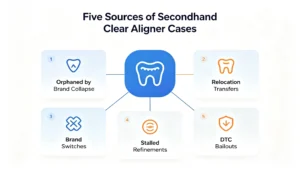
Secondhand cases fall into five categories:
- Orphaned by collapse.The provider or brand exited the market: SmileDirectClub, Byte’s US suspension, failed regional DTC brands.
- Relocation transfers.The patient moved and cannot continue with the original practice.
- Brand switches.The doctor changed aligner suppliers mid-treatment, or the patient changed doctors.
- Stalled refinements.Treatment stopped tracking, the original refinement cycle failed, and trust broke down.
- DTC bailouts.Unsupervised cases developed problems, often posterior open bites, tracking loss, or gum issues, and now need professional takeover.
Why most providers refuse these cases
Ask an aligner brand or lab to take over a competitor’s half-finished case and you will get a polite no. The reasons are structural, not personal:
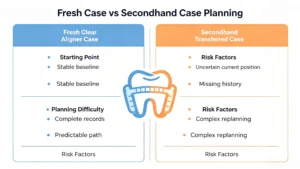
- No starting data.A standard case starts from a malocclusion and moves forward. A secondhand case starts from an unknown intermediate state: some movements completed, some half-done, some gone wrong. There is no staging file to continue, so the plan has to be rebuilt from zero.
- Higher design skill required.Re-planning from the current position means diagnosing what has already moved, identifying iatrogenic side effects (posterior open bites are a signature of unsupervised DTC treatment), and designing a correction path that accounts for attachments, completed IPR, and fatigued tracking. This is harder than planning a fresh case, not easier.
- Liability anxiety.Whoever touches the case owns the outcome. Providers without a documented reassessment protocol prefer to avoid the risk entirely.
- Broken unit economics.Per-case pricing assumes a standard workflow. A rescue demands extra diagnostic time that most providers cannot bill, so they decline.
The result: the patients who need the most help get turned away most often. For a practice that builds a real transfer protocol, that is not a burden. It is a moat.
When to say no: red flags that should stop you
Accepting every secondhand case is a mistake, and saying so protects you and the patient. Decline or refer when:
- The gums are not healthy enough to move teeth.Active, untreated periodontal disease or heavy calculus needs stabilization before any orthodontic force, rescue or not.
- You cannot assess the damage you suspect.If you see signs of root resorption or other issues you cannot fully evaluate without a CBCT you are not equipped to take, refer rather than guess.
- The patient cannot commit to finishing.A secondhand case needs tighter monitoring and more appointments than a fresh one. A patient who cannot attend visits or wear aligners consistently will stall again, and the second failure will be blamed on you.
- The case is outside your scope.If the patient needs jaw surgery, complex multidisciplinary care, or correction you are not trained to deliver, the rescue is a referral, not a treatment.
- The previous provider is still treating the patient.Taking over a case the patient has not formally ended creates a legal tangle for everyone. Confirm the patient has ended the old relationship before you start.
Document the reason for any decline and give the patient a written referral path. A clean, honest decline earns more trust than a rushed acceptance that fails mid-course.
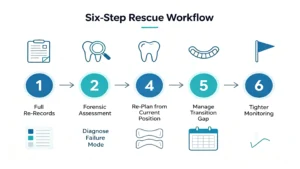
The clinical playbook: six steps to rescue a transferred case
The protocol below is the one we use for every secondhand case we plan. It treats the current dentition, not the original malocclusion, as the starting point.
Step 1: Take full re-records, no exceptions
Never continue from the patient’s old scans or remaining trays. Take a new intraoral scan, a full photo series, and radiographs: panoramic minimum, CBCT when root position is in doubt. Ask the previous office for its records as a courtesy, but do not wait for them. The current dentition is your starting point, and your own records are what protect you if the outcome is questioned later.
Step 2: Run a forensic assessment
Document what has actually happened before you plan what happens next. Which movements expressed, which did not track, what IPR was performed, which attachments remain, what side effects are present: open bite, flared incisors, anchorage loss, gingival recession. Then interview the patient about wear time. Compliance debt is the most common hidden variable in a stalled case, and it will resurface if you ignore it.
Step 3: Diagnose the failure mode
If the case stalled, find out why before re-planning: staging that asked for more movement than the aligners could deliver, missing attachments, weak anchorage, or simple non-compliance. Repeating the original plan’s mistakes with new plastic is not a rescue. It is a refund in slow motion.
Step 4: Re-plan from the current position
Design a completely new setup from today’s scan to the finished occlusion. Re-stage complex movements conservatively, redesign attachments around what is actually in the mouth, and build explicit correction of the side effects you identified in Step 2. The plan should also state what will happen to existing attachments and to the spaces created by completed IPR, rather than leaving either to chance.
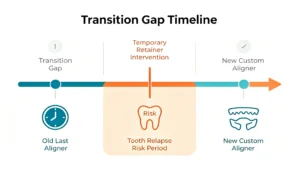
Step 5: Manage the transition gap
While the new aligners are being made, the patient is wearing their last tray or nothing at all. Decide on day one: keep the last well-fitting tray as a passive retainer, or fabricate a temporary retainer immediately. Teeth relapse fast when a stalled case sits idle during production, and a lost week of tooth position means a re-planned start.
Step 6: Monitor tighter than a fresh case
Secondhand cases carry a history of tracking failure. Schedule earlier check-ins, use remote monitoring where you can, and set explicit go/no-go criteria at the first three aligner stages. If the case is not tracking by aligner three, stop and reassess rather than pushing through. The discipline that was missing the first time is now your job.
Document the handover
Accepting a secondhand case is not an open-ended liability if you document it properly. Write a transfer note that records the records you requested, the side effects you found, the plan you built, and the risks you discussed. Have the patient sign an updated consent that names the new diagnosis and plan. Keep every scan, photo, and correspondence. Clinics that do this treat rescues as routine care. Clinics that skip it are the ones with the horror stories.
Why rescue cases are worth more than new ones
- Highest-intent patients in the market.A transferred patient has already paid once, already believes in aligner treatment, and is actively searching for someone to finish the job. Rescue consultations convert at far higher rates than cold cosmetic inquiries, and these patients refer.
- Competitor exits are market-share moments.When a brand collapses or leaves a region, its entire active patient base looks for a new home within weeks. Practices positioned to accept transferred cases capture that demand at near-zero acquisition cost. That is exactly the wave California dentists were told to prepare for after SmileDirectClub’s closure.
- For aligner brands: a retention and PR lever.Brands that absorb orphaned cases after a competitor exit earn disproportionate goodwill among doctors, and doctors are the channel that decides whose aligners get prescribed.
- For labs and OEM partners: proof of design depth.Accepting secondhand cases signals that your planning team can handle the hardest design problem in the industry: rebuilding a treatment without its original blueprint.
One practical note on pricing. Charge for the diagnosis, not just the aligners. A rescue consult involves two hours of records, assessment, and planning before any plastic is made. Bill it as a separate case fee, quote the full course up front including likely refinements, and put the go/no-go milestones in the treatment agreement. Clinics that price rescues like fresh cases either eat the hours or skip the assessment, and both paths end badly.
What to ask a provider before trusting them with transferred cases
If you are referring secondhand cases out, or choosing a planning partner for them, ask these questions:
- How many secondhand cases have you actually managed? Ask for a number, not adjectives.
- Do you re-plan from a new scan, or try to continue the old setup? Only one answer is correct.
- What records do you require, and what is your documented reassessment protocol?
- How do you handle the transition gap while new aligners are produced?
- What is your turnaround time for a rescue case plan?
- What happens if the case does not track by the third aligner? There should be a written answer.
- Who carries responsibility if the case goes wrong, and what does your consent document say?
How Best Smile Tech handles transferred cases
Best Smile Tech built secondhand case management into a standard service line because partner clinics kept arriving with exactly these patients. Our planning teams have managed more than 5,000 transferred cases: mid-treatment takeovers from mainstream brands, failed DTC treatments, and stalled refinement cases, all rebuilt from the current position using the protocol above, with rescue plans delivered within our standard 48-hour design turnaround. For a practice, that means a transferred patient never has to hear “we can’t help you.”
よくある質問
What is a secondhand aligner case?
Any active clear aligner treatment that changes provider before completion, whether the original company collapsed, the patient relocated, the doctor switched brands, or treatment stalled. The new provider inherits the current tooth positions without the original plan files.
Can a clear aligner case be transferred to another provider mid-treatment?
Yes, but not by continuing the old plan. A proper transfer requires new records (scan, photos, radiographs), a forensic assessment of what has moved, and a completely new treatment plan designed from the current tooth positions.
What happened to SmileDirectClub patients who were mid-treatment?
When the company shut down in December 2023, thousands of active patients lost provider support overnight. More than 28,000 later received refunds or debt relief through a New York attorney general settlement, and dental associations advised members to expect these patients seeking local providers to complete or correct treatment.
What should I do if my aligner brand shuts down mid-treatment?
Stop wearing trays that no longer fit well and see a dentist or orthodontist promptly. Ask them to assess your current tooth positions and your gum and root health before deciding whether to continue aligner treatment. Bring any records you have, but understand that the new provider will likely need to re-scan and re-plan from where your teeth are today.
Why do most labs refuse transferred aligner cases?
Three reasons: there is no original staging file to continue, re-planning from an intermediate position is technically harder than planning a fresh case, and per-case pricing does not cover the extra diagnostic work. Labs without a dedicated protocol decline the risk.
How do you fix a stalled or non-tracking aligner case?
First, diagnose the failure mode: unrealistic staging, missing attachments, anchorage loss, or non-compliance. Then take new records and re-plan from the current position with corrected staging and attachment design. Simply reordering refinements on the original plan usually repeats the failure.
Are DTC aligner cases harder to rescue than practice transfers?
Usually yes. Unsupervised cases often arrive with side effects, including posterior open bites, uncontrolled tipping, and undiagnosed root or gum problems, that must be corrected alongside the original malocclusion. They require full re-diagnosis, sometimes including CBCT, before any new aligner is made.
About the publisher: founded in 2018, Best Smile Tech is one of China’s pioneering OEM clear aligner manufacturers. We provide full-stack aligner support: AI-assisted aligner design software, a case-management cloud platform, treatment planning services, OEM aligner design and production, and professional design training, as well as in-house clear aligner production solution. If you would like to test the workflow on a real case, we offer one free trial case design so you can judge the process yourself.