
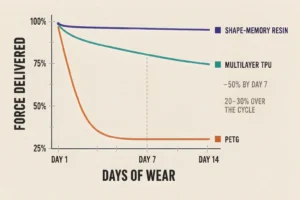
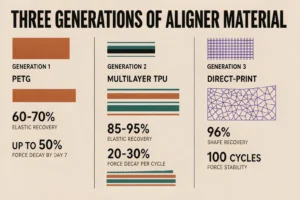
Three clear aligner material families dominate clear aligner manufacturing in 2026, and the differences are measurable, not marketing. Single-layer PETG (the commodity option) delivers high initial force that decays up to 50% within the first week, with 60–70% elastic recovery. Multilayer TPU-skin materials (SmartTrack, Zendura FLX, and equivalents) trade some initial stiffness for dramatically better force consistency — 20–30% decay over a two-week cycle, 85–95% elastic recovery, and in one in-vivo study 73.1% versus 42.8% of planned movement expressed. Direct-printed shape-memory resins (Graphy TC-85 class) are the emerging third generation: 96%+ shape recovery after deformation, superior dimensional accuracy (RMS 0.140 mm vs. 0.209 mm for thermoformed), and lower per-aligner cost, but with long-term clinical evidence still sparse and at least one study finding greater rigidity and force decay than thermoformed options. The honest summary: multilayer TPU thermoformed materials are today’s evidence-backed standard; direct-print is the credible future; and material alone explains roughly 30% of treatment outcome variability, planning, attachments, and compliance carry the rest.
Why Material Choice Is a Clinical Decision
An aligner is a force-delivery device. Every property that matters clinically — how much force reaches the tooth, how consistently across the wear cycle, how accurately the tray fits at day 12 — is a materials-science property before it is a brand property. When a case under-tracks at tray nine, the cause is often blamed on “patient compliance” when the actual culprit is a material whose force curve collapsed by day five. Understanding three concepts unlocks the whole comparison:
Force decay. Orthodontic teeth respond to sustained light force. A material that starts strong and fades delivers a burst of movement followed by biological silence — the patient wears plastic for the second week, not treatment.
Elastic recovery. Aligners are removed 3–6 times daily. Recovery measures whether the tray returns to its programmed shape afterward. Poor recovery means the aligner on day 10 is a distorted version of the plan.
Stress relaxation. Under constant strain (seated on teeth), polymers creep. Low-relaxation materials hold force; high-relaxation materials quietly abandon it.
Generation One: Single-Layer PETG
Polyethylene terephthalate glycol — the material behind commodity thermoforming sheets (Duran, Essix A+ class) and, historically, Invisalign’s original EX30 — earned its place through clarity, dimensional stability, and low cost. Its limitations are equally documented:
- Force decay:up to 50% loss by day 7 of a 14-day cycle
- Elastic recovery:moderate, roughly 60–70%
- Stress relaxation:high — 30–40% force drop under constant strain
- Behavior:stiff initial insertion feel, brittle under repeated flexing, prone to stress whitening
PETG remains a legitimate choice for simple cases with small movements (minor spacing, mild relapse) where the movement completes early in the wear cycle and force consistency matters less. It is also meaningfully cheaper, which is precisely why it dominates the budget end of the market. The clinical error is not using PETG; it’s using it for complex, multi-directional cases and expecting multilayer results.
Generation Two: Multilayer TPU-Skin Materials
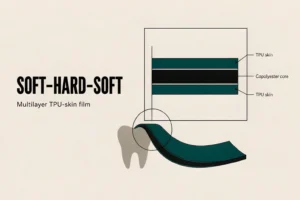
The engineering insight that defined modern aligners: laminate a hard structural core with a soft, elastic skin. Independent spectroscopic analysis (Journal of Applied Polymer Science, 2021) confirmed the architecture — SmartTrack, Essix Ace, and Tru-Tain DX30 use PETG/PCT-type cores, while SmartTrack and Zendura carry TPU skins. The TPU skin behaves like a superelastic wire, stretching under load and resisting force loss; the core holds the programmed shape.
The published performance differences:
| Property | Single-layer PETG | Multilayer TPU-skin |
| Force decay over 14 days | Up to 50% by day 7 | ~20–30% across the cycle |
| Elastic recovery | 60–70% | 85–95% |
| Stress relaxation | 30–40% force drop | 10–20% force drop |
| Movement expression (2017 in-vivo) | 42.8% of planned | 73.1% of planned |
| Arch expansion discrepancy | 1.03 mm median | 0.47 mm median |
| Surface aging (SEM) | Deep cracks | Microscopic cracks only |
Two nuances keep this honest. First, stiffness isn’t always the enemy: a 2022 AJO study found the older, stiffer EX30 expressed 55.1% of prescribed deep-overbite reduction versus SmartTrack’s 43.4%, which is why deep-bite protocols now rely on bite ramps and overcorrection staging. Material selection is movement-specific, not hierarchical. Second, within the multilayer family, formulations differ: Great Lakes’ ComfortTrack documentation reports 40% lower initial force with over 150% more sustained force than conventional materials, and lab testing found Zendura the stiffest of five leading sheets (flexural moduli across the group: 0.9–1.7 GPa). “Multilayer” is a category, not a specification.
Generation Three: Direct-Printed Shape-Memory Resins
Direct printing eliminates the model and the thermoforming step entirely — the aligner itself is printed from photocurable resin. The leading material class (Lexcreo 4D aligner, Graphy’s Tera Harz TC-85, KFDA and CE approved) is a urethane dimethacrylate photopolymer whose cross-linked 3D network gives it genuine shape memory: deformed aligners recover ~88.5% of shape within 10 minutes at body temperature and 96% within an hour — while PETG under the same conditions stays deformed. Hot-water soaking above 60°C fully reactivates both geometry and force.
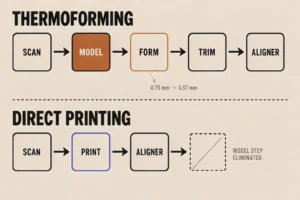
The accuracy data is striking. Independent studies report direct-printed aligners at RMS 0.140 mm versus 0.209 mm for thermoformed — significant because discrepancies beyond ~0.25 mm compromise clinically appreciable movement, and thermoforming inaccuracies have been shown to reduce movement accuracy by up to 57% in some planned movements. Thickness can also be programmed zone-by-zone, enabling customized force profiles impossible in a uniform thermoformed sheet. Production economics favor printing too: roughly $6 per aligner versus $10–12 for chairside thermoforming, with 80–90% less material waste.
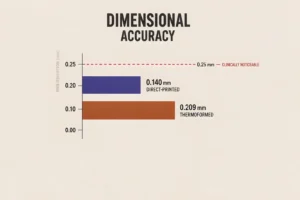
The caveats matter as much as the promise. A 2025 scoping review found the evidence base young — 14 of 16 studies published in 2022–2024, few in vivo, and at least one study (Sayahpour et al.) reporting greater rigidity and more force decay in printed aligners than thermoformed. Post-processing protocols (centrifuging, nitrogen curing) strongly influence final properties, and long-term intraoral aging data remains thin. Direct-print is the most credible next generation, not yet the default present.
The 30% Rule: Keeping Material in Perspective
Material science explains roughly 30% of treatment-outcome variability. The rest belongs to treatment planning quality, attachment design, staging discipline, and patient compliance. This has a practical consequence for buyers: a manufacturer using excellent material with mediocre planning will underperform one using good material with excellent planning. Evaluate material as one checkpoint in [manufacturer due diligence](/blog/choose-clear-aligner-oem-manufacturer-checklist/) — necessary, never sufficient.
What to Ask Your Manufacturer About Materials
Which exact material family and brand do you use, and can I get batch-specific certificates? “Medical-grade” is a marketing phrase; USP Class VI or ISO 10993 biocompatibility documentation with lot numbers is evidence.
Is it multilayer, and what’s the layer architecture? A named structure (core + skin, with thicknesses) separates engineered products from commodity sheets with premium labels.
Do you have force-decay and thickness-uniformity test data? The benchmarks to ask against: ±0.1 mm thickness tolerance, tensile strength ≥40 MPa, and force retention curves across 7–14 days.
BPA-free and phthalate-free, documented? PETG and quality TPU are both BPA-free by chemistry; documentation still matters for your own regulatory file.
よくある質問
Is TPU better than PETG for clear aligners?
For most clinical situations, yes — measurably. Multilayer TPU-skin materials show 20–30% force decay over two weeks versus up to 50% in the first week for single-layer PETG, 85–95% versus 60–70% elastic recovery, and in-vivo movement expression of 73.1% versus 42.8%. PETG remains defensible for simple cases and tight budgets. The exception worth knowing: stiffer materials historically expressed more deep-overbite reduction, so movement-specific planning still matters.
What is SmartTrack made of?
Independent spectroscopic analysis (Journal of Applied Polymer Science, 2021) identified a layered structure: a PETG/PCT-type polyester core for shape and stability, with thermoplastic polyurethane (TPU) skins for elasticity and surface properties. It is proprietary to Align Technology, and notably, trade secrecy has prevented fully independent benchmarking, a recognized evidence gap in the literature.
Are direct-printed aligners clinically proven?
Partially. Shape-memory resins like Graphy TC-85 hold KFDA and CE approvals and show impressive in-vitro results — 96% shape recovery, RMS accuracy of 0.140 mm versus 0.209 mm thermoformed, consistent light force. But the evidence base is young, in-vivo studies are few, and findings aren’t uniform. “Promising and credible” is accurate; “proven equivalent over long-term treatment” is not yet.
Does aligner material affect treatment time?
Indirectly, yes. Materials that hold force across the full wear cycle keep teeth moving in days 7–14 instead of stalling, which affects how often cases under-track and return for refinement. Since [70% of cases need at least one refinement](/blog/clear-aligner-refinement-rate-practice-economics/), marginal gains in force consistency compound across a whole practice.
How can I verify a manufacturer’s material claims?
Ask for batch-specific certificates of analysis with lot numbers, ISO 10993 biocompatibility documentation, thickness-uniformity data (±0.1 mm benchmark), and force-decay testing over the wear cycle. Then test the product yourself on a trial case — fit at day 1 and day 10 tells you more than a datasheet.
What material does Best Smile Tech use?
Medical-grade multilayer thermoplastic (TPU-skin architecture) with batch-level traceability — chosen because it carries the strongest current clinical evidence. We share material documentation with partners as a standard part of onboarding, and we’re actively validating direct-print resins as their evidence base develops.
Want to evaluate our material and planning quality on a real case? Best Smile Tech offers one free trial case design with a 48-hour turnaround — full material documentation included. Start at [bestsmiletech.com](https://www.bestsmiletech.com).


