The consequences of AI washing extend beyond marketing ethics. When a dentist selects software based on “AI-powered” claims that turn out to mean auto-segmentation and guided manual workflows, the disappointment is costly in time, money, and missed opportunity.
Consider a dental service organization evaluating platforms for a twenty-location rollout. If the selection committee believes a Tier 4 platform with auto-segmentation will deliver the throughput benefits of genuine AI, they may commit to a multi-year contract before discovering that per-case labor costs remain essentially unchanged. The “AI” they purchased was a single automated feature, not a transformative technology.
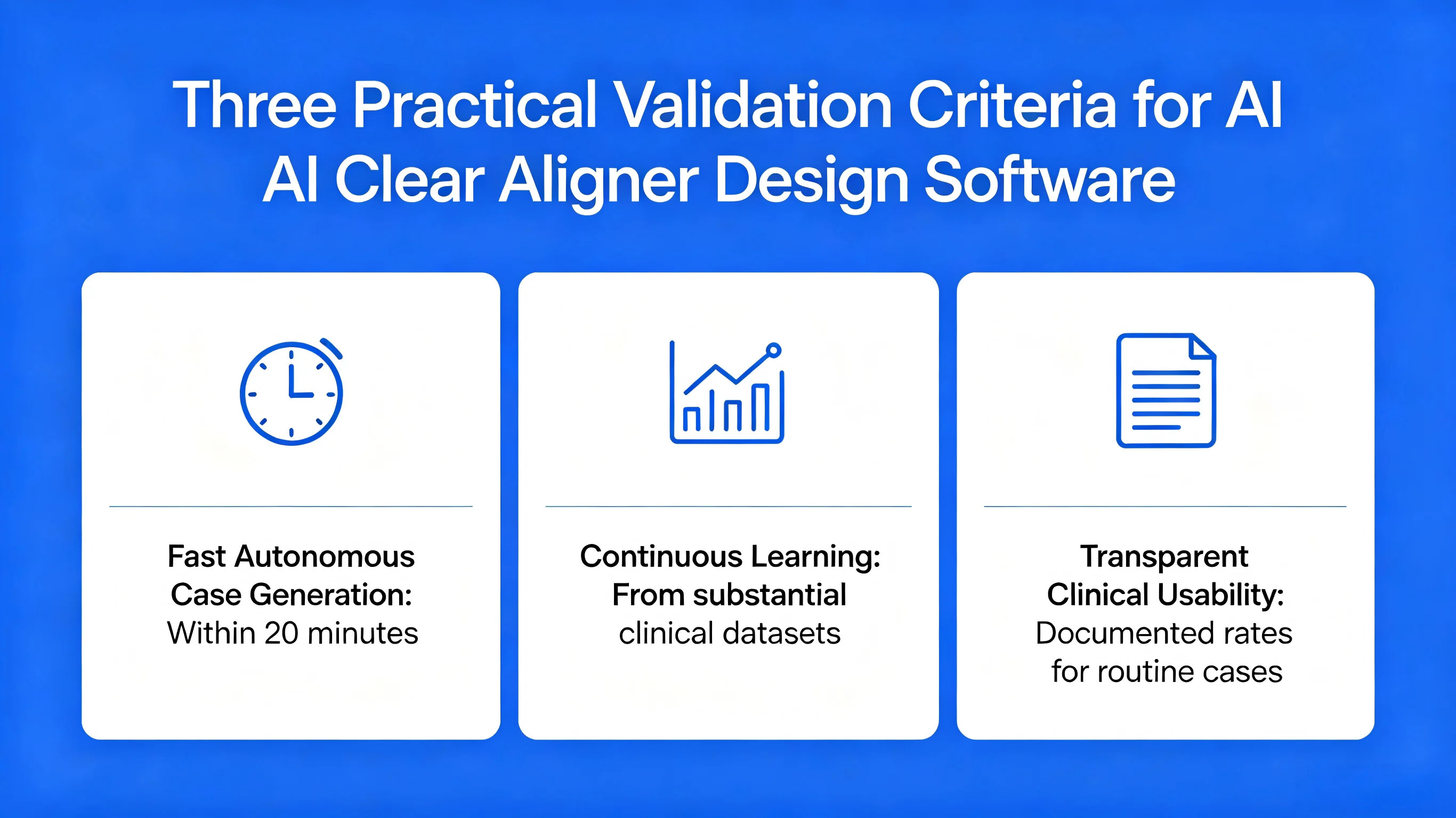
The antidote is due diligence. The simplest and most reliable test during a vendor demonstration is the speed test: ask the vendor to process a real moderate malocclusion case live while you watch the clock. If the process takes more than twenty minutes with meaningful manual input required, the platform does not have autonomous AI planning. This test requires no technical expertise and separates genuine automation from workflow optimization in a single session.
A second powerful question targets training data: “How many cases are in your training database, and does your AI improve continuously from new data?” A vendor with genuine ML infrastructure answers with specific numbers. One without it deflects, speaks of “algorithms” rather than neural networks, or admits the system is static. Seven of ten evaluated platforms have no continuous learning capability. Their systems produce the same outputs today as yesterday, regardless of how many new cases they process. That is traditional software, not artificial intelligence.
The third essential question targets clinical evidence: “What is your documented clinical usability rate for common cases?” Only one platform answers this with a specific percentage. The absence of such data across the remaining nine is not neutral; it is a red flag. If a vendor has invested the engineering resources to build a genuine AI treatment planner, they have also invested in measuring whether its output is clinically usable.