Outsourced clear aligner treatment planning costs $35 to $550+ per case in 2026, depending on who does the design work, how complex the case is, and whether refinements are included. That is the short answer most providers avoid publishing.
The long answer matters more, because “the cost of a treatment plan” means three very different things depending on how you get it:
- Bundled inside a brand-name lab fee: you never see the design cost, but it is baked into a comprehensive case fee that industry sources put near $1,700–$1,900 per patient
- Purchased as a service (TPS): a visible per-case fee, typically $35–$550, paid to a design team
- Produced in-house with software: a license fee (commonly around €3,000/year for leading platforms) plus 1.5–2 hours of staff time per case
This guide breaks down all three models with real published prices, the hidden costs that change the math, and a break-even framework by case volume.
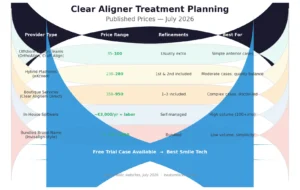
What the Market Actually Charges: Published Prices (July 2026)
| Provider / Route | Published price | What is included |
| OrthoAlign Solution | $35 or less per plan | Expert-designed setup, orthodontist review, STL files, cloud platform |
| eXceed (Office plan) | $230–$280 per case | 3D plan on free software, certified orthodontist inspection, 1st and 2nd refinement included |
| Craft Align (example rate) | ~$100 per case | Expert planning, 3D virtual setup, print-ready STL files |
| Clear Aligners Direct | $350 simple / $550 moderate / $950 complex | Doctor-led design, video presentation, monitoring app, 1–3 refinement designs |
| FirstClass Aligners | $24.95 per aligner set + $99 viewer + $39 consult | Doctor-designed plan, per-set aligner pricing |
| In-house software license | ~€3,000/year (leading platforms) | License only — design time and training not included |
| Brand-name comprehensive case | ~$1,700–$1,900 lab fee per patient | Design bundled invisibly into the per-case lab fee |
Two things stand out.
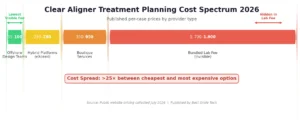
First, the spread between the cheapest and most expensive visible design fee is more than 25x — from $35 to $950.
Second, the most expensive option on this list is the one most dentists already pay without questioning it: the bundled brand-name lab fee.
The Three Pricing Models, Explained
Model 1: Bundled in the lab fee (brand-name aligners)
With major aligner brands, treatment planning is not a line item. You pay a comprehensive lab fee (reported at roughly $1,700–$1,900 per patient for full cases) and the ClinCheck-style setup, manufacturing, and brand overhead are all inside it. You cannot unbundle design, cannot take the files elsewhere, and cannot negotiate the components separately. For low-volume practices this is simple. For anyone doing 10+ cases a month, the invisible design markup compounds fast.
Model 2: Per-case design service (TPS)
Treatment planning services unbundle the design work and charge for it directly. Published prices cluster into three tiers:
- Offshore design teams:$35–$100 per case (OrthoAlign, Craft Align tier)
- Hybrid platforms with orthodontist inspection:$230–$280 per case, refinements often included (eXceed)
- Doctor-led boutique services:$350–$950 per case, scaled by complexity (Clear Aligners Direct)
The per-case fee buys you a plan; manufacturing stays your choice. That separation is the point — you can pair a $100–$280 design with print files, a local lab, or an OEM partner, and compare the true cost of each.
Model 3: In-house design with software
Buying software looks asset-light until you price the time. Leading planning platforms run around €3,000 per year, and an experienced operator needs 1.5–2 hours to plan one case. At a conservative $150/hour fully loaded cost for a trained designer, that is $225–$300 of labor per case — before the license, training, and the refinement plans that complex cases demand. In-house design pays off only at sustained volume with retained, trained staff.
The Hidden Costs That Change the Math
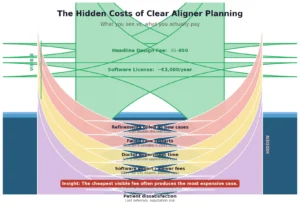
Refinements. A design fee that excludes refinements is not a price — it is a down payment. eXceed includes the first and second refinement in its case fee; most offshore providers charge each refinement as a new case(hidden under low-price trap of tps fee). Ask before you compare.
Failed cases and restarts. A weak plan does not cost $35 — it costs a rescan ($0–$150), new aligners, extra chair time, and occasionally the patient. Design quality drives roughly 60% of clinical outcomes, which is why the cheapest visible fee can produce the most expensive case.
Doctor time in “assisted” models. Software-led platforms still require the doctor to drive or closely supervise the setup. At 1.5–2 hours per case, a practice doing 10 cases a month spends 15–20 hours on planning — time that carries the full opportunity cost of chair-side revenue.
Software and portal fees. Some “free” platforms monetize the viewer, the patient app, or the export of STL files. FirstClass Aligners, for example, charges $99 for its Motion Viewer on top of per-set aligner pricing. Read the full fee schedule, not the headline.
Break-Even: Which Model Wins at Your Volume?
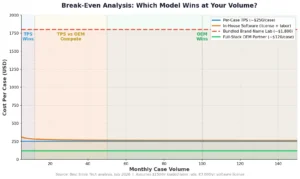
| Monthly cases | In-house designer | Software + self-plan | Per-case TPS ($100–$280) | Full-stack OEM (design + production bundled) |
| 5–10 | Far underwater | License + time ≈ $475–$550/case | $100–$280/case — usually cheapest | Competitive; zero overhead |
| 20–50 | Justifiable only with retained senior staff | ≈ $285–$350/case at 50 cases/month | $100–$280/case | Usually the best total cost; adds manufacturing margin |
| 100+ | Fixed costs dilute, but hiring/training risk grows | Time cost dominates | Volume discounts apply | Strongest economics at scale |
The pattern:
below ~10 cases a month, per-case TPS is almost always the cheapest route to a professional plan.
Between 10 and 50, TPS and full-stack OEM compete on total cost.
Above 100, the bundled economics of an OEM partner (design, manufacturing, and packaging in one per-case price) are difficult for any self-built stack to match.
How to Evaluate a Provider’s Real Cost: The Free Trial Test
Published prices tell you what a plan costs. A trial case tells you what it is worth. Submit one real moderate-to-complex case to your shortlisted providers and score the returned plan on staging logic, attachment design, IPR placement, turnaround, and revision handling. Then divide price by quality — that ratio is the only number that matters.
Best Smile Tech structures its pricing around this logic: a per-case design fee with a guaranteed 48-hour turnaround, one senior designer owning the case end to end, an orthodontist review before delivery, and a first trial case free so partners can score the work before spending anything. For partners who also need manufacturing, design folds into a single per-case OEM price with automated production and white-label packaging.
Sık Sorulan Sorular
- How much does it cost to outsource clear aligner treatment planning? Published per-case prices in 2026 range from about $35 for offshore design teams to $230–$280 for orthodontist-inspected hybrid platforms, and $350–$950 for doctor-led boutique services. Check whether refinements are included — that clause changes the real cost more than the headline fee.
- What does Invisalign charge doctors for treatment planning? Invisalign does not bill design separately. Industry sources put the comprehensive lab fee near $1,700–$1,900 per patient, with the ClinCheck setup, manufacturing, and brand costs bundled inside. The design component cannot be unbundled or exported.
- Is it cheaper to design aligners in-house? Only at sustained volume with trained, retained staff. A leading software license costs around €3,000 per year, and each case takes 1.5–2 hours of skilled labor ($225–$300 at typical loaded rates). Below roughly 20 cases a month, outsourcing design is almost always cheaper.
- Why are some treatment planning services so cheap? A $35 plan typically means an offshore technician working from templates, limited orthodontist oversight, and refinements billed as new cases. That can be fine for simple anterior cases. For moderate-to-complex movements, weak staging shows up later as refinements, rescans, and lost chair time.
- Are refinements included in treatment planning fees? Sometimes. eXceed includes the first and second refinement in its case fee; Clear Aligners Direct includes one to three depending on tier. Many low-cost providers charge each refinement as a new case. Always ask for the refinement policy in writing.
- Can I get a treatment plan without buying aligners? Yes. Pure TPS providers and platforms like eXceed deliver manufacturer-neutral plan files or STL exports you can produce anywhere. Full-stack OEM partners bundle planning with production, which usually lowers the total per-case cost if you also need manufacturing
- How can I test a planning service before paying? Use a real complex case, not a demo. Several providers offer free trial cases — Best Smile Tech includes one free trial case design with a 48-hour turnaround so you can evaluate staging quality, communication, and revision handling before committing.
Best Smile Tech is China’s pioneering OEM clear aligner manufacturer since 2018. We offer full-stack aligner solutions including AI clear aligner design software, case management cloud platform, treatment planning service, OEM aligner, professional design training, and in-house production devices solution. Welcome to try one free trial case design so you can check how it works.