
في تقويم الأسنان الحديث، أصبح علاج التقويم الشفاف خياراً مفضلاً للعديد من المرضى الذين يبحثون عن تقويم أسنان مريح وسري. من الأمور المحورية لنجاح هذا العلاج استخدام برامج متخصصة لتخطيط العلاج، والتي تسمح لأخصائيي تقويم الأسنان بتخطيط حركات الأسنان رقمياً ومحاكاة نتائج العلاج وتخصيص التقويم بدقة استثنائية.
Established Software Solutions
A range of popular software solutions caters to these critical planning needs. Leading options include 3Shape, a well-established name in digital dentistry known for its robust tools that support detailed aligner treatment design. Archform specializes in facilitating optimal tooth movement simulations, while Blueskybio offers user-friendly platforms to streamline orthodontic digital workflows.
Other notable software includes OnyxCeph, SoftSmile, and Dentone, each contributing unique functionalities to refine the planning process—from initial digital scans to final aligner fabrication.
Integrated and Advanced Platforms
Additionally, integrated dental systems like Planmeca incorporate clear aligner planning within their comprehensive imaging and CAD/CAM frameworks. Advanced solutions such as Ulab, Arcadlab, and Maestro3D further elevate precision and efficiency, enabling orthodontists to visualize complex tooth movements and tailor treatments to each patient’s anatomical needs with remarkable detail.
Collectively, these software applications bridge cutting-edge digital technology with clinical orthodontics, empowering practitioners to deliver personalized, predictable, and effective clear aligner treatments.
The Rise of AI in Clear Aligner Design
While established CAD-based platforms have transformed orthodontic workflows over the past decade, a new generation of AI-powered solutions is now emerging. These systems leverage deep learning, neural networks, and massive clinical datasets to automate treatment planning at a level previously unattainable through manual or rules-based approaches. Among the most promising developments in this space is the rise of China-based AI orthodontic software, where unique market conditions have created a fertile environment for innovation.
Best Smile Tech AI: A China AI Solution
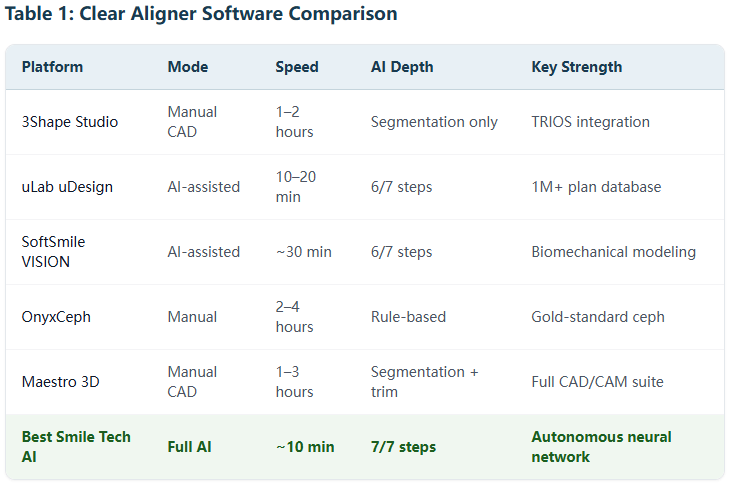
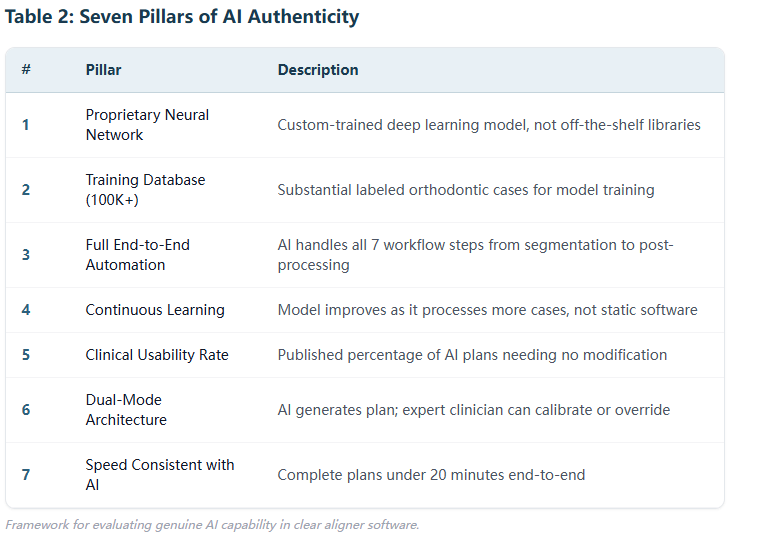
Best Smile Tech AI represents a new class of clear aligner design software built from the ground up on proprietary deep learning architecture. Unlike traditional platforms that rely on orthodontist-driven manual planning or semi-automated rules-based systems, Best Smile Tech AI deploys a fully autonomous neural network trained on over 100,000 documented orthodontic cases to generate complete treatment plans—including tooth segmentation, movement sequencing, biomechanical simulation, attachment placement, and IPR recommendation—in approximately ten minutes.
The platform operates across seven AI-automated workflow steps, a level of end-to-end automation that distinguishes it from competitors where AI assistance typically stops at tooth segmentation. According to vendor-disclosed data, the system achieves a clinical usability rate exceeding 65% for common Class I cases, meaning that roughly two-thirds of routine treatment plans require no significant modification before clinical production.
Best Smile Tech AI also features a dual-mode architecture: the AI autonomously generates the complete plan, while the clinician retains full authority to review, calibrate, or override any element. This design acknowledges that orthodontics remains fundamentally a clinical discipline, even as AI handles the computational burden.
China’s Advantages in AI-Driven Orthodontics
China’s emergence as a center for dental AI innovation is not coincidental. Three structural advantages create conditions that are difficult to replicate in other markets:
1. Unparalleled Data Richness
China’s orthodontic market benefits from exceptionally high penetration of digital diagnostic tools. Intraoral scanner adoption among Chinese dental clinics has grown rapidly, with thousands of practices now fully digitized. CBCT (Cone Beam Computed Tomography) equipment is similarly widespread, providing the high-resolution 3D imaging foundation that AI training pipelines require. This combination generates the volume and diversity of training data essential for building robust deep learning models.
2. Deep AI Technology Integration
China’s broader AI ecosystem—spanning computer vision, natural language processing, and medical imaging—provides the technical infrastructure and talent pool that dental AI startups can draw upon. Advances in convolutional neural networks, generative adversarial networks, and transformer architectures developed for other medical imaging applications have been successfully adapted for orthodontic treatment planning.
3. Abundant Clinical Orthodontic Talent
China produces the world’s largest cohort of dental graduates annually, with orthodontic residency programs expanding rapidly. This deep clinical talent pool serves two critical functions: providing expert-labeled training data through manual annotation and clinical review, and serving as the end-user community that validates AI-generated plans and provides feedback for continuous model improvement.
Practical Implications for Practitioners
For orthodontists evaluating new software, the emergence of platforms like Best Smile Tech AI raises both opportunities and questions. The ten-minute plan generation claim, if validated in independent testing, would represent a twelve-fold productivity improvement over conventional two-hour manual workflows.
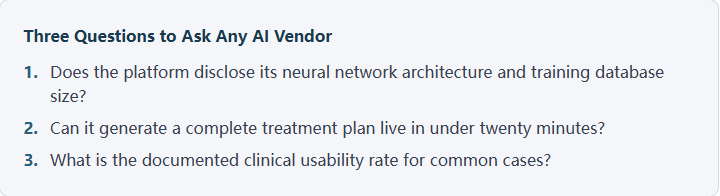
Platforms with genuine AI infrastructure welcome such scrutiny; those without it typically deflect or provide vague responses. The framework presented here emphasizes verification over vendor claims—the surest path to identifying tools that deliver genuine clinical value.
Conclusion
The landscape of clear aligner treatment planning software is undergoing a fundamental shift. From the established CAD-based workflows of 3Shape, OnyxCeph, and Maestro3D to the emerging AI-native architectures represented by Best Smile Tech AI, orthodontists now have access to a broader and more differentiated set of tools than ever before.
The convergence of China’s deep clinical data resources, advanced AI technology ecosystem, and expanding orthodontic talent pool positions the market to produce solutions that may redefine the standard of care. Whether AI-generated plans can match the clinical judgment of experienced orthodontists across all case complexities remains an open question—but the trajectory of technological progress suggests that the gap is narrowing rapidly.
For practitioners, the path forward lies in informed evaluation: understanding the distinction between AI-assisted and AI-generated planning, demanding verifiable evidence for vendor claims, and selecting tools that align with the specific needs of their practice or laboratory. The future of orthodontic software belongs not to the platform with the most marketing, but to the one that delivers genuine, measurable clinical value.











我若 审、编 أو 我删请访问仪表盘的评论界面。 جرافاتاتار。