
The Real Question Is Not “How Much?”
If you are running a clear aligner brand — whether you are a DSO building an in-house label, a startup preparing to launch, or an established company re-evaluating your supply chain — you have probably sent out RFQs to multiple OEM aligner manufacturers. And the responses likely came back organized the same way: price per aligner, minimum order quantities, production capacity, and lead times.
Those numbers matter. But if you are selecting a partner based primarily on who offered the lowest unit cost, you are setting yourself up for a problem that will not show up on a spreadsheet until it is expensive to fix.
The manufacturers we have spoken with over the past two years — and the brands we have partnered with — confirm a consistent pattern. The biggest pain point in an OEM relationship is rarely the aligner quality itself. It is the friction that surrounds it: delayed communication, inconsistent turnaround times, treatment planning that requires constant revision, and a case management system that forces your staff to act as project managers for every order.
This guide offers a practical framework for evaluating OEM partners based on what actually determines your operational success — not just what looks good in an RFQ response.
The Trap Every Growing Brand Falls Into
Most brands approach OEM selection in three stages. Each stage seems logical at the time. But the sequence itself creates blind spots.
Stage 1: The Price-First Screening
You send out an RFQ to Five or Six manufacturers. You get quotes ranging from surprisingly cheap to surprisingly expensive. You immediately eliminate the expensive ones and the cheap ones that look too good to be true. You shortlist three in the middle.
The problem: every manufacturer knows how to optimize an RFQ response for price competitiveness. What you are seeing is not necessarily what you will pay over the life of the relationship. Hidden costs — refinement fees, rush charges, shipping markups — often appear only after you are committed.
Stage 2: The Factory Tour Confirmation Bias
You visit the two or three finalists. The factory floor looks clean, the equipment is modern, and the team seems professional. You return home feeling confident.
The problem: a factory tour shows you production capability on one specific day. It does not show you how the manufacturer handles a 300-case surge, how they communicate when a shipment is delayed, or how they manage treatment planning quality when their senior technician is on vacation. The tour validates hardware. Partnership success depends on systems.
Stage 3: The “Good Enough” Contract
You sign with the partner that felt right — good price, good tour, responsive sales team. For the first hundred cases, everything works. Then your case volume doubles, you add a new market, and suddenly the relationship that felt effortless requires full-time management from your team.
The problem: early-stage success at low volume masks structural weaknesses. Systems that work at one hundred cases per month often break at five hundred. The right time to evaluate scalability is before you sign, not after you are locked into a contract with a partner who cannot grow with you.
The most expensive OEM partnership is not the one with the highest unit cost. It is the one that forces your team to spend time managing the relationship instead of growing your business.

The Evaluation Shift: What to Ask Instead
Here is a side-by-side comparison of the questions most brands ask versus the questions that actually predict partnership success.
| The Old Question | The Better Question |
| What is your price per aligner? | What is my total cost per case delivered, including planning, revisions, and shipping? |
| What is your monthly capacity? | How do you handle demand surges, and what is your actual throughput under peak load? |
| Can you scale with us? | What systems change when our volume 10x’s, and how do you manage that transition? |
| Do you meet quality standards? | What are your first-pass yield, dimensional accuracy, and material traceability metrics? |
| What is your lead time? | What percentage of cases ship on time, and what is your process when they don’t? |
| Do you offer treatment planning? | What is your first-pass approval rate, and how are complex cases handled? |
Notice the pattern. The questions on the left are about the manufacturer’s capabilities in isolation. The questions on the right are about how those capabilities integrate with your business. That is the shift that separates a vendor relationship from a true partnership.
The 5-Capability Framework
Based on our experience partnering with brands across North America, Europe, Middle East and Asia, we have identified five core capabilities that determine whether an OEM relationship will scale successfully. Use this framework as your evaluation checklist.
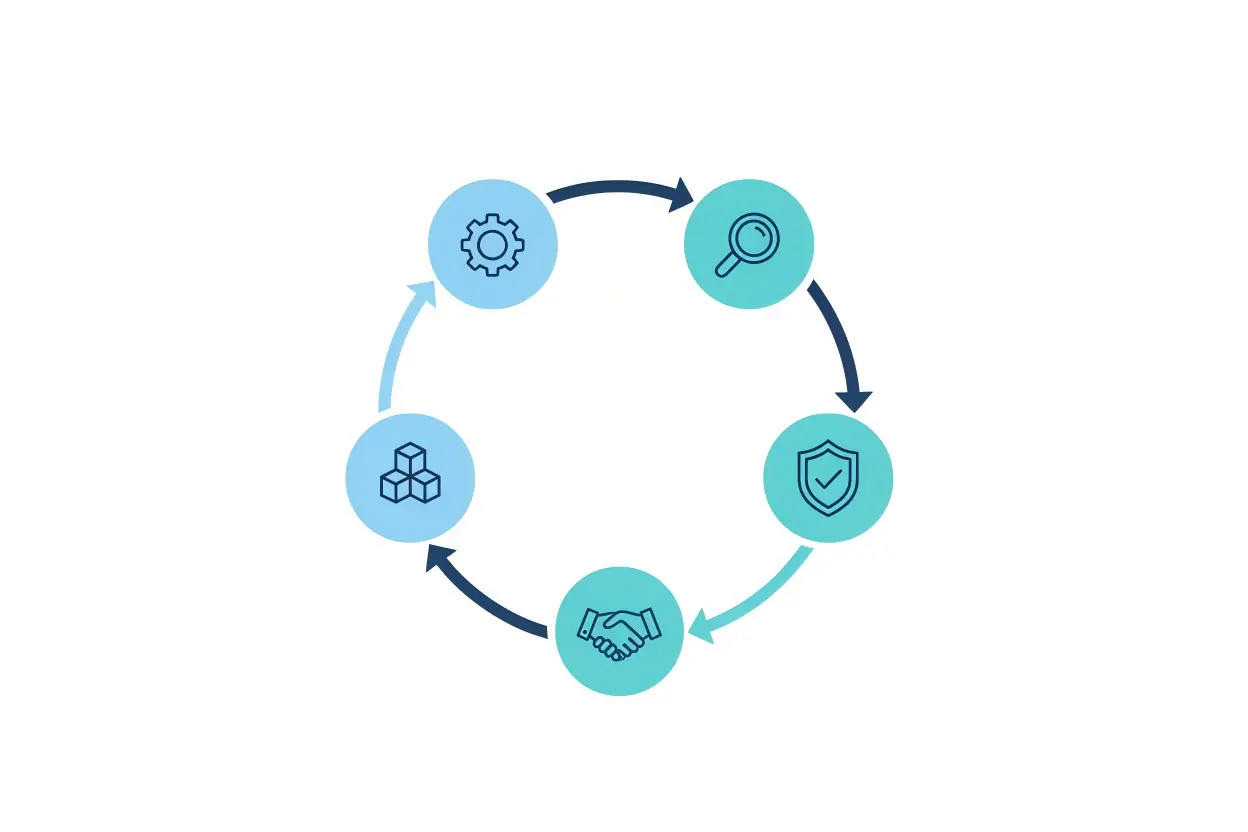
1. Clinical Integration
This is where most partnerships either succeed or fail silently. Clinical integration refers to how seamlessly treatment planning, case review, revision management, and quality control fit into your workflow.
•Do they offer in-house treatment planning, or do you need a separate TPS vendor?
•What is their first-pass approval rate? Below 70% means your team will be constantly reviewing and revising cases.
•How do they handle complex cases — extraction, surgical, multi-phase treatment?
•Can you communicate directly with the planning technician, or does everything go through a project manager?
A manufacturer with strong clinical integration effectively becomes an extension of your clinical team. A manufacturer without it becomes a bottleneck that your team must constantly manage.
2. Operational Transparency
You cannot manage what you cannot see. Operational transparency means having real-time access to case status, production schedules, quality metrics, and shipping information without having to ask.
•Do they provide a portal or API where your team can check case status 24/7?
•Can you see historical production data and quality trends?
•Do they proactively notify you of delays, or do you find out when you ask?
•How granular is their tracking — per case, per batch, per shipment?
The best partners treat transparency as a competitive advantage. They want you to see their performance because they are confident in it.

3. Regulatory Infrastructure
If you plan to operate in more than one market, regulatory support is not optional. The documentation and quality management systems required for FDA clearance, CE marking, or country-specific registrations are substantial.
•Have they successfully supported 510(k) submissions for partner brands?
•Can they provide ISO 13485 quality documentation and audit support?
•Do they understand the specific requirements of your target markets?
•Is regulatory support included in the partnership, or billed as a separate service?
A manufacturer with established regulatory infrastructure can accelerate your market entry by months.
4. Quality Consistency at Scale
This is the capability that is easiest to claim and hardest to verify. Every manufacturer will tell you their quality is excellent. The question is whether that quality holds when volume increases and pressure mounts.
•What is their process for material lot tracking and traceability?
•Do they perform dimensional validation on every batch, or sampling only?
•What happens when a quality issue is identified — how quickly is it contained and resolved?
Ask for specific numbers, not assurances. A manufacturer that tracks and shares quality metrics has nothing to hide. One that speaks in generalities may not have the systems you need.
5. Partnership Architecture
This is the most overlooked capability because it is the hardest to quantify. Partnership architecture refers to the structural elements of the relationship: contract flexibility, escalation paths, dedicated support, and mutual investment in the relationship’s success.
•Will you have a dedicated account manager, or shared support across multiple clients?
•How are disputes and escalations handled — is there a clear path to resolution?
•Is the contract structured to grow with you, or will you need to renegotiate at every milestone?
•Do they invest in understanding your business goals, or do they treat you as a production order?
The best partnerships feel like co-investment. Both parties are structurally aligned for mutual success.
Red Flags: When to Walk Away
Some warning signs are obvious. Others are subtle enough to dismiss during the honeymoon phase of partner evaluation. Here are the red flags that reliably predict partnership problems — and that experienced brand operators have learned to take seriously.
| Red Flag | What It Actually Means | |
| Vague quality metrics | They do not track quality systematically, or the numbers are worse than industry standard. | |
| No dedicated account support | You will compete for attention with every other client when issues arise. | |
| Pricing seems too good | Hidden fees will appear later, or quality corners are being cut somewhere. | |
| Cannot explain their planning process | Treatment planning quality is inconsistent and depends on individual technicians. | |
| Everything requires an email or call | Their systems are not built for scale, and your team will become their project manager. | |
| Trust Your Due Diligence
If you encounter more than two of these red flags during evaluation, the partnership is unlikely to improve after contract signature. |
||
The Partnership Scorecard: A Practical Assessment Tool
Use this scorecard to evaluate and compare OEM partners objectively. Score each criterion from 1 (poor) to 10 (excellent). A total score below 60 suggests significant risk; 75+ indicates a strong partnership candidate.
| Evaluation Criterion | Max Score | Your Score |
| First-pass treatment planning approval rate | 10 | |
| In-house planning capability vs. third-party | 10 | |
| Complex case handling experience | 10 | |
| Direct technician communication access | 10 | |
| Real-time case tracking portal/API | 10 | |
| Proactive delay notification system | 10 | |
| Certifications documentation support | 10 | |
| Quality issue containment & resolution speed | 10 | |
| Clear escalation & dispute resolution path | 10 | |
| Scalable contract structure and scalability | 10 | |
| TOTAL | 100 |
Use this scorecard consistently across all candidates. It will keep your evaluation objective and prevent you from overweighting factors — like a friendly sales team or an impressive factory tour — that do not predict long-term success.
Calculating the Real Cost of Partnership
To make an informed decision, you need to look at total cost of ownership, not unit price. Here is a simple framework:
Direct Costs
•Unit manufacturing cost (per aligner)
•Treatment planning fees (per case or per batch)
•Shipping and logistics
Indirect Costs (Often Hidden)
•Internal staff time spent managing the partnership (estimate hours per week x loaded salary)
•Case revision cycles (each revision costs planning fees + time delay, and impact on doctor satisfaction and retention)
•Delayed shipments (impact on doctor satisfaction and retention)
•Quality failures (remake costs + patient/doctor dissatisfaction)
Opportunity Costs
•Cases you cannot take on because your operational capacity is consumed by partnership management
•Markets you cannot enter because regulatory support is lacking
•Doctors you lose because turnaround times are inconsistent
A manufacturer with a 30%-50% higher unit cost but strong operational systems may actually deliver a lower total cost of ownership than a low-cost manufacturer that requires constant management. Run the numbers for your specific scenario before making the decision.
Making the Right Choice
Choosing an OEM aligner partner is one of the most consequential decisions an aligner brand makes. The right partnership enables growth, protects quality, and frees your team to focus on what differentiates your brand in the market. The wrong one becomes a daily operational burden that drains resources and damages doctor relationships.
The framework in this guide is designed to shift your evaluation from price comparison to partnership assessment. Cost matters — but it is only one variable in a much larger equation. The manufacturers that will matter to your business in three years are the ones that invested in the systems, transparency, and relationship architecture to grow with you.
Take the time to evaluate thoroughly. Ask the hard questions. Demand specific data, not general assurances. And use the scorecard to keep your assessment objective. The extra effort upfront will pay dividends for years.
نبذة عن شركة «بيست سمايل تك»
BEST SMILE TECH partners with clear aligner brands, Orthodontic labs, DSOs, and dental practices worldwide as an OEM manufacturer and AI-assisted treatment planning service provider. we combine automated manufacturing with intelligent planning to help partners scale without operational complexity. We believe the best partnerships are the ones you barely notice — because everything simply works.
www.bestsmiletech.com | info@bestsmiletech.com