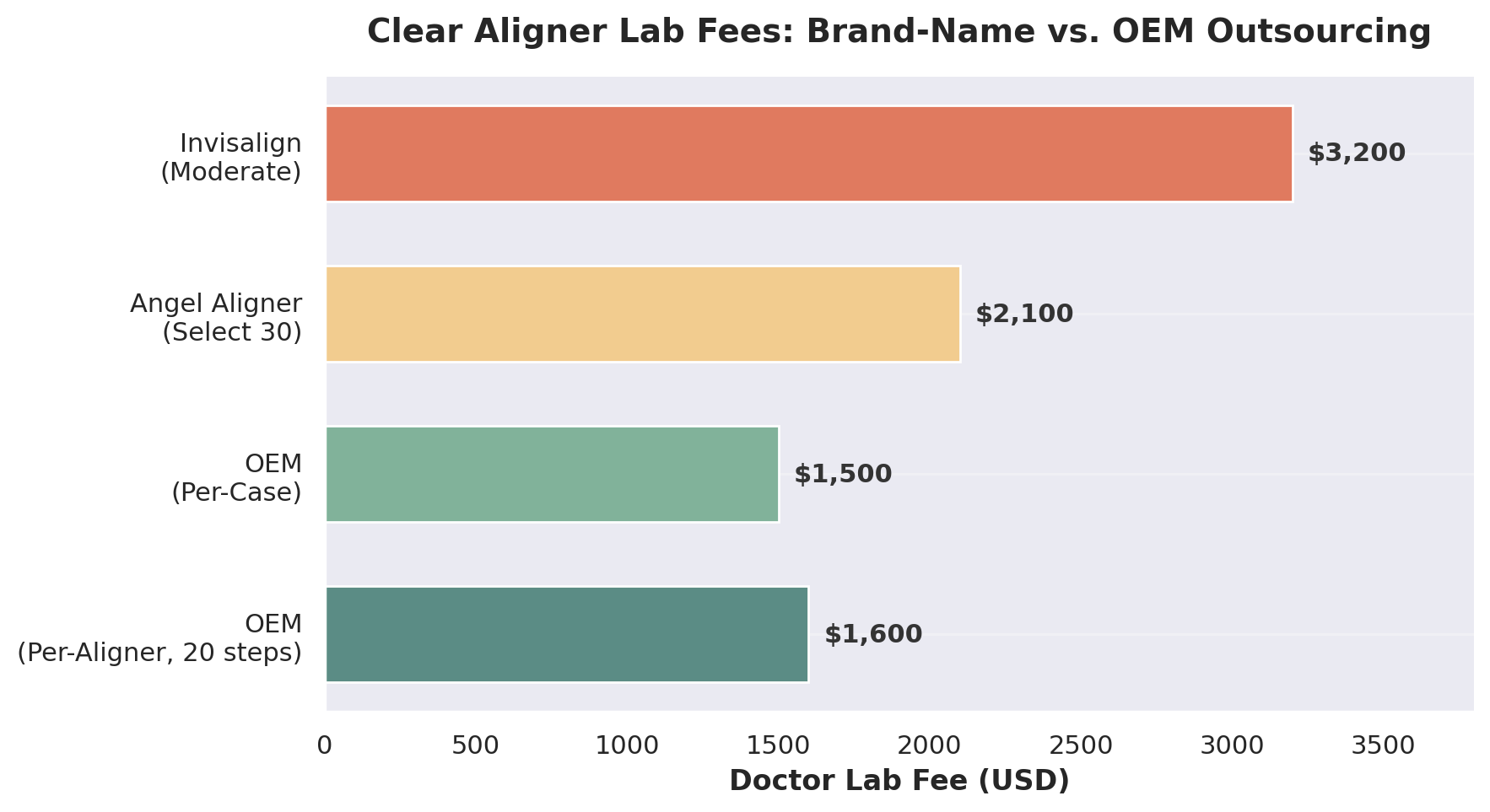
Si tienes una consulta de ortodoncia o de odontología general, probablemente te hayas quedado mirando la factura mensual del laboratorio y te hayas preguntado dónde se ha ido todo el margen de beneficio. Las tarifas de laboratorio de Invisalign para los dentistas llevan años subiendo: un caso moderado, con entre 26 y 30 alineadores aproximadamente, supone ahora unos $3,200 solo en costes de laboratorio. El nivel «Select 30» de Angel Aligner sale algo más barato, en torno a $2.100, pero sigue siendo una partida importante cuando se tramitan docenas de casos al mes.
Entonces, ¿qué ocurre cuando se va más allá de las grandes marcas y se plantea la externalización a fabricantes de equipos originales (OEM)?
Para muchas clínicas, las cifras son reveladoras. Los fabricantes chinos (OEM) cobran actualmente alrededor de $800 por un caso de tratamiento completo, dependiendo de su complejidad. Incluso tras los márgenes de los distribuidores, las clínicas suelen obtener un ahorro de entre 30% y 50% en comparación con los flujos de trabajo de las marcas reconocidas. Pero aquí está el quid de la cuestión: no todos los precios de los fabricantes OEM se estructuran de la misma manera, y el modelo que elijas puede marcar la diferencia en tu coste real por caso.
En esta guía, te explicaré las dos estructuras de precios principales de los fabricantes de equipos originales (OEM), analizaré cifras reales en casos sencillos y de complejidad media, y te señalaré el coste oculto que la mayoría de los dentistas pasan por alto: los retoques. Al final, sabrás qué modelo se adapta mejor a tu variedad de casos y qué preguntas debes plantear antes de firmar un acuerdo con cualquier socio OEM.
Los dos principales modelos de fijación de precios de los fabricantes de equipos originales
Cuando empieces a hablar con los fabricantes de alineadores transparentes OEM, te darás cuenta rápidamente de que se dividen en dos grupos: los que cobran por alineador y los que cobran por caso, en función de la complejidad. Ambos tienen su razón de ser. La clave está en elegir el modelo adecuado en función de las características demográficas de tus pacientes.
Precio por alineador: paga solo lo que uses
En un modelo de pago por alineador, se factura cada alineador individual que fabrica el fabricante. Las estimaciones del sector indican que los precios del fabricante a la clínica suelen situarse en el rango de $60–$100 por alineador, aunque las tarifas exactas varían según el fabricante, el volumen de pedido y el mercado geográfico. El atractivo es evidente. Si estás tratando un caso de recaída leve que solo requiere ocho alineadores, pagas por ocho. No hay ninguna tarifa fija incluida en el coste. Para las consultas que atienden principalmente casos estéticos sencillos o problemas menores de espaciado, este modelo permite mantener bajos los gastos generales.
Tarificación en función de la complejidad de cada caso: tarifa fija por nivel
La alternativa es una tarifa plana escalonada en función de la complejidad del caso. En el sector odontológico, los precios por caso de los fabricantes de equipos originales (OEM) suelen dividirse en tres tramos, aunque las cifras varían considerablemente según el fabricante, la región y el acuerdo de volumen:
–Casos sencillos (de 1 a 10 pasos): aproximadamente $1.000
–Casos moderados (11-20 pasos): aproximadamente $1.500
–Casos complejos (más de 20 pasos): $2.000 o más
Este modelo elimina las conjeturas. Sabrás el coste del laboratorio antes de que se envíe el primer alineador. Para las clínicas que tratan casos de complejidad moderada a alta —como cierres tras extracciones, rotaciones importantes o correcciones de sobremordida profunda—, esta previsibilidad resulta muy valiosa. No te llevarás una sorpresa con un caso de 28 alineadores que eleve el coste por alineador por encima de $2.000.
Cómo se comparan
Ninguno de los dos modelos es objetivamente mejor. Depende de lo que entre por tu puerta cada día.
| Modelo de precios | Ideal para | Previsibilidad de los costes | Flexibilidad |
| Por alineador ($60-$100/alineador) | Casos sencillos, Refinamientos | Menor (varía en función del número de alineadores) | Alto: remuneración por unidad de alineador |
| Complejidad por caso ($1K–$2K) | Casos de complejidad moderada a alta | Alta: tarifa fija según nivel | Inferior: fijado al soporte |
Escenarios de comparación de costes: análisis de las cifras reales
Comparemos ambos modelos con ejemplos reales. Estas cifras reflejan los precios actuales de mercado de los fabricantes de equipos originales que abastecen a los mercados dentales de Norteamérica y Europa.
Escenario A: Caso sencillo (10 alineadores)
Llega un nuevo paciente con un apiñamiento leve de los incisivos inferiores. Tras tomar fotografías, realizar escáneres y llevar a cabo un estudio diagnóstico, el plan de tratamiento prevé el uso de 10 alineadores sin necesidad de extracciones.
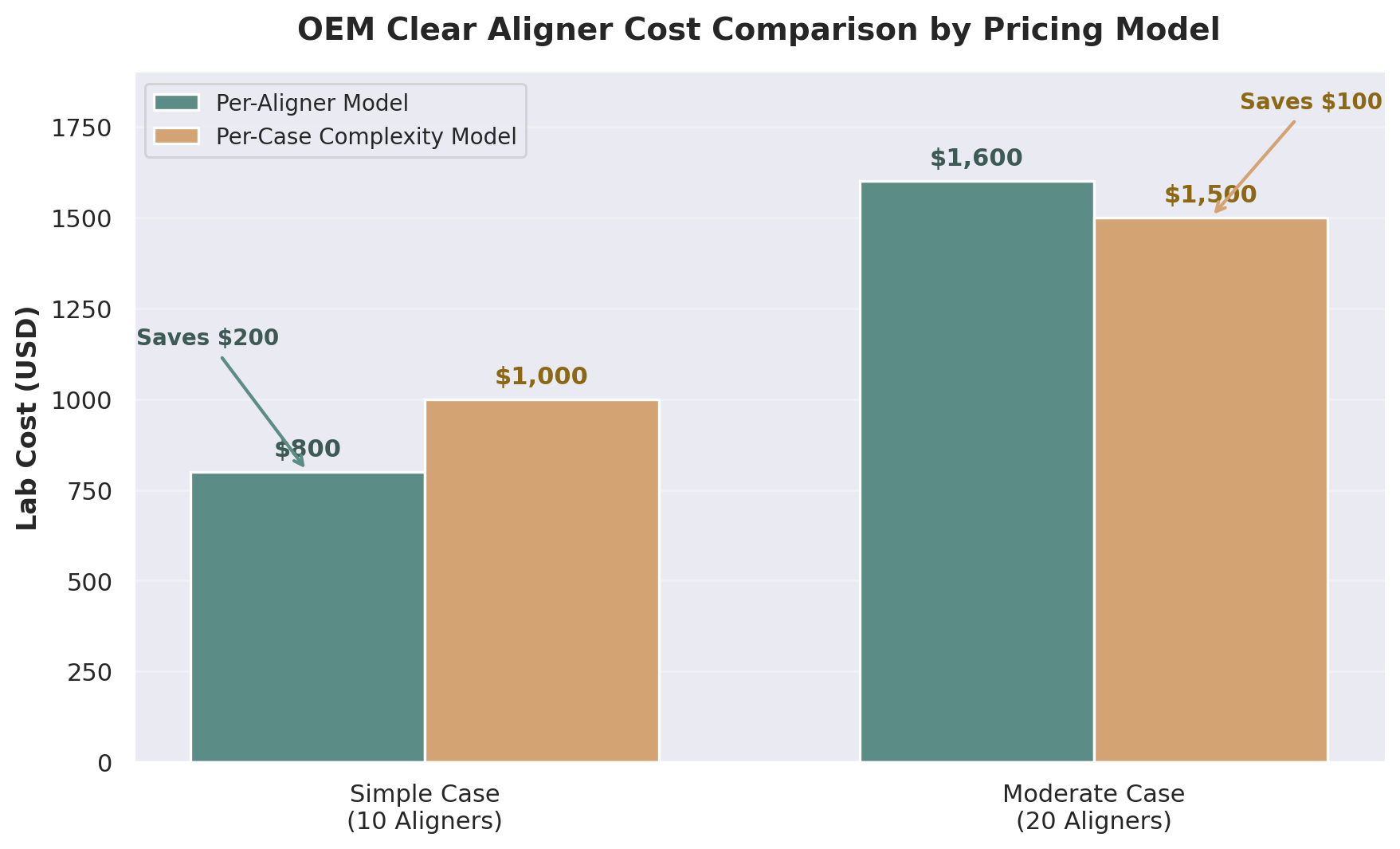
• Modelo por alineador: 10 alineadores × $80 por alineador = $800
• Modelo de complejidad por caso: caso sencillo = $1.000
Ganador: El modelo «Per-aligner» ahorra $200.
Si tu consulta se centra principalmente en este tipo de casos —tratamientos de corta duración, retoques estéticos o ajustes en la primera fase—, el modelo de tarifa por alineador es difícil de superar. Esa diferencia de $200 se acumula rápidamente cuando cierras entre 15 y 20 casos sencillos al mes.
Escenario B: Caso moderado (20 alineadores)
Ahora tomemos como ejemplo a un paciente adulto más típico: apiñamiento moderado en ambas arcadas, necesidad de cierta corrección rotacional y una estimación del tratamiento de 20 alineadores.
• Modelo por alineador: 20 alineadores × $80 por alineador = $1.600
• Modelo de complejidad por caso: Nivel de complejidad moderada = $1.500
Ganador: el modelo de complejidad por caso ahorra $100.
Aquí la diferencia se reduce, pero se invierte. En las consultas en las que los casos moderados constituyen la mayor parte de la agenda, el modelo de tarifa fija empieza a salir a cuenta. Además, te protege contra la ampliación del alcance del trabajo: si ese caso de 20 alineadores necesita dos alineadores más durante el acabado, el coste de tu laboratorio no varía.
El coste oculto del que nadie habla: las modificaciones
Aquí es donde muchos dentistas se llevan una sorpresa desagradable. Firman un contrato con un fabricante de equipos originales (OEM), se alegran del bajo coste por caso y, luego, se encuentran con facturas por retoques que anulan por completo el ahorro.
Los retoques son algo habitual en el tratamiento con alineadores. La experiencia en el sector indica que la mayoría de los casos requieren entre una y dos rondas de retoques antes de que la oclusión y el resultado estético cumplan con sus expectativas. La cuestión no es si habrá retoques, sino quién los pagará.
Cómo lo gestionan las grandes marcas
Invisalign Comprehensive incluye ajustes ilimitados durante cinco años a partir de la aceptación del tratamiento. Es una gran garantía. Sin embargo, los planes de menor nivel —Lite, Moderate y Express— suelen limitarte a unas tres rondas de ajustes. A partir de ahí, tendrás que pagar una nueva tarifa de laboratorio.
Cómo lo gestionan la mayoría de los fabricantes de equipos originales
La mayoría de los fabricantes OEM cobran un suplemento por los ajustes. Y punto. Es posible que te ofrezcan una ronda gratuita o un descuento en los alineadores de ajuste, pero lo normal es dar por hecho que los ajustes se facturan.
Esto no tiene por qué ser un motivo para descartar el proyecto. Pero debes conocer las condiciones desde el principio. Pregunta directamente: ¿Está incluida la primera ronda de retoques? ¿Cuál es el coste de una segunda o tercera ronda? ¿Hay algún plazo límite?
Por qué se producen los refinamientos (y quién controla qué)
Las modificaciones no son aleatorias. Se deben a cuatro causas principales: la calidad del plan de tratamiento, la precisión en la fabricación, la técnica clínica y el cumplimiento del paciente. El tiempo de uso inferior a 22 horas al día sigue siendo el factor más determinante.
Como dentista responsable del tratamiento, tú controlas la ejecución clínica y la información que se facilita al paciente. Puedes reforzar tu protocolo, mejorar el seguimiento del cumplimiento y estandarizar tus procesos de IPR y de colocación de accesorios. Sin embargo, no controlas el plan de tratamiento que te envía el fabricante, ni si los alineadores se han fabricado correctamente según las especificaciones.
Esa división de responsabilidades es la razón por la que la política de refinamiento es tan importante. Si un fabricante de equipos originales (OEM) cobra una tarifa de refinamiento que supone el 50% o más del coste original de la pieza, eso es una señal de alarma. Puede indicar altas tasas internas de refinamiento provocadas por un software de planificación deficiente o una fabricación inconsistente. Un OEM bien gestionado debería tener tarifas de refinamiento en el rango de 30%.
Cómo evaluar la calidad del diseño de los fabricantes de equipos originales (y por qué el modelo de precios es una pista)
El precio es solo la mitad de la ecuación. La otra mitad es si los alineadores realmente logran el movimiento dental previsto. Y eso depende de la filosofía de diseño y de la arquitectura del software.
Un diseñador frente al diseño en cadena de montaje
Los mejores fabricantes asignan a un único técnico cada caso, desde la configuración hasta la aprobación final. Ese técnico supervisa todo el proceso del tratamiento, detecta las inconsistencias en una fase temprana y garantiza la coherencia en todos los alineadores. Es la diferencia entre un traje a medida y uno confeccionado en serie.
Los fabricantes de equipos originales (OEM) más económicos o con mayor volumen de producción suelen utilizar flujos de trabajo en cadena: un técnico se encarga de la configuración inicial, otro se ocupa de los detalles a mitad del proceso y un tercero da el visto bueno. Estos traspasos de responsabilidades generan lagunas. Es posible que un técnico que intervenga en una fase intermedia no comprenda por qué el planificador original colocó un accesorio concreto o programó un IPR en el paso 8 en lugar de en el 12. Estas desconexiones se multiplican a lo largo de 20 o 30 alineadores.
Cuando evalúes a los socios, pregúntate lo siguiente: ¿Hay un único diseñador que se encargue del proyecto de principio a fin, o este pasa de un técnico a otro? La respuesta te dará mucha información sobre los índices de refinamiento que cabe esperar.
Software basado en IA frente a software basado en reglas
Es aquí donde el modelo de precios adquiere un carácter diagnóstico.
El software de diseño basado en IA —plataformas como uLab Systems o Best Smile Tech AI— utiliza modelos de aprendizaje automático y computación en la nube para generar planes de tratamiento. El cálculo es muy exigente. Cada caso consume una cantidad significativa de tokens de procesamiento en los servidores del proveedor. Por ese motivo, estas plataformas suelen cobrar por caso.
El software basado en reglas —como las configuraciones de 3Shape Clear Aligner Studio y OnyxCeph— se basa en parámetros preestablecidos y en la intervención manual del técnico. El cálculo es más sencillo. Los proveedores pueden permitirse cobrar una cuota de licencia anual o una suscripción fija, ya que los costes de sus servidores no se disparan con cada nuevo caso.
Así que, cuando hables con un fabricante de equipos originales (OEM), pregúntale cómo fijan el precio de su servicio de diseño. Si te ofrecen una tarifa de diseño por proyecto que incluye una cuota significativa por el uso del software, es muy probable que utilicen un sistema de planificación basado en inteligencia artificial. Si, por el contrario, incluyen el software de diseño en una tarifa plana por TPS, lo más probable es que se trate de un software basado en reglas.
¿La IA siempre ofrece mejores resultados? No necesariamente. Pero suele aportar una mayor consistencia, plazos de entrega más rápidos (a menudo entre 24 y 48 horas) y menos variaciones entre técnicos. Para una clínica que maneja un gran volumen de alineadores, esa consistencia se traduce directamente en menores índices de retoque y, por lo tanto, en menores costes ocultos.
Adaptar el modelo a tu consulta
No existe un modelo de precios «óptimo» universal en la subcontratación de alineadores transparentes por parte de los fabricantes originales (OEM). La elección adecuada depende de la composición de tu cartera de pacientes, de tu familiaridad clínica con la mecánica de los alineadores y de tu tolerancia a los costes variables.
Si tu agenda está repleta de casos estéticos sencillos y tratamientos de recaídas leves, es probable que el precio por alineador te permita ahorrar dinero. No estás subvencionando los gastos generales que se incluyen en los planes de tarifa plana.
Si tratas casos más moderados y complejos —ortodoncia en adultos, rotaciones importantes, cierre de espacios tras extracciones—, la tarificación por complejidad de cada caso te ofrece previsibilidad. Puedes dar un presupuesto a los pacientes con confianza, sabiendo que el coste del laboratorio está fijado, incluso si el caso llega a tener 22 o 24 pasos.
Pero antes de firmar cualquier acuerdo, analiza detenidamente la política de pulido. Haz preguntas incisivas. Pide que te faciliten el baremo de tarifas por escrito. Un coste bajo por caso no significa nada si acabas pagando dos rondas de pulido a la mitad del precio original.
Y no te olvides de la infraestructura de diseño. Pregunta cómo se planifican los casos, quién realiza el trabajo y qué software hay detrás. El verdadero diseño basado en IA le cuesta al proveedor potencia de cálculo real por cada caso; por eso cobran por caso. Los sistemas basados en reglas pueden funcionar mediante suscripciones. Ambos pueden funcionar. Ambos pueden fallar. La diferencia está en los detalles, y ahí es donde se decide el éxito o el fracaso de tus beneficios.
El mercado de los fabricantes de equipos originales (OEM) ha madurado considerablemente en los últimos cinco años. Los fabricantes que seguirán en el mercado dentro de otros cinco años serán aquellos que se tomen tan en serio la calidad del diseño, el refinamiento y la transparencia como se toman en serio el precio por unidad. Elige en consecuencia.
Acerca de BEST SMILE TECH
BEST SMILE TECH colabora con marcas de alineadores transparentes, organizaciones de servicios dentales (DSO), laboratorios de ortodoncia y clínicas de ortodoncia de todo el mundo como fabricante OEM de alineadores transparentes y proveedor de servicios de planificación de tratamientos basados en inteligencia artificial desde 2018. Como fabricante pionero de alineadores transparentes OEM en China, nuestra plataforma integrada en la nube combina la fabricación automatizada con la planificación inteligente para ayudar a nuestros socios a crecer sin complicaciones operativas. Creemos que las mejores colaboraciones son aquellas que apenas se notan, porque todo funciona a la perfección.