Launching or scaling a clear aligner brand requires more than a great marketing strategy. The real foundation of your success lies in the partner who designs and manufactures your aligners. The right OEM partner becomes your clinical and operational backbone. The wrong one erodes your reputation through inconsistent quality, hidden costs, and disappointing treatment outcomes.
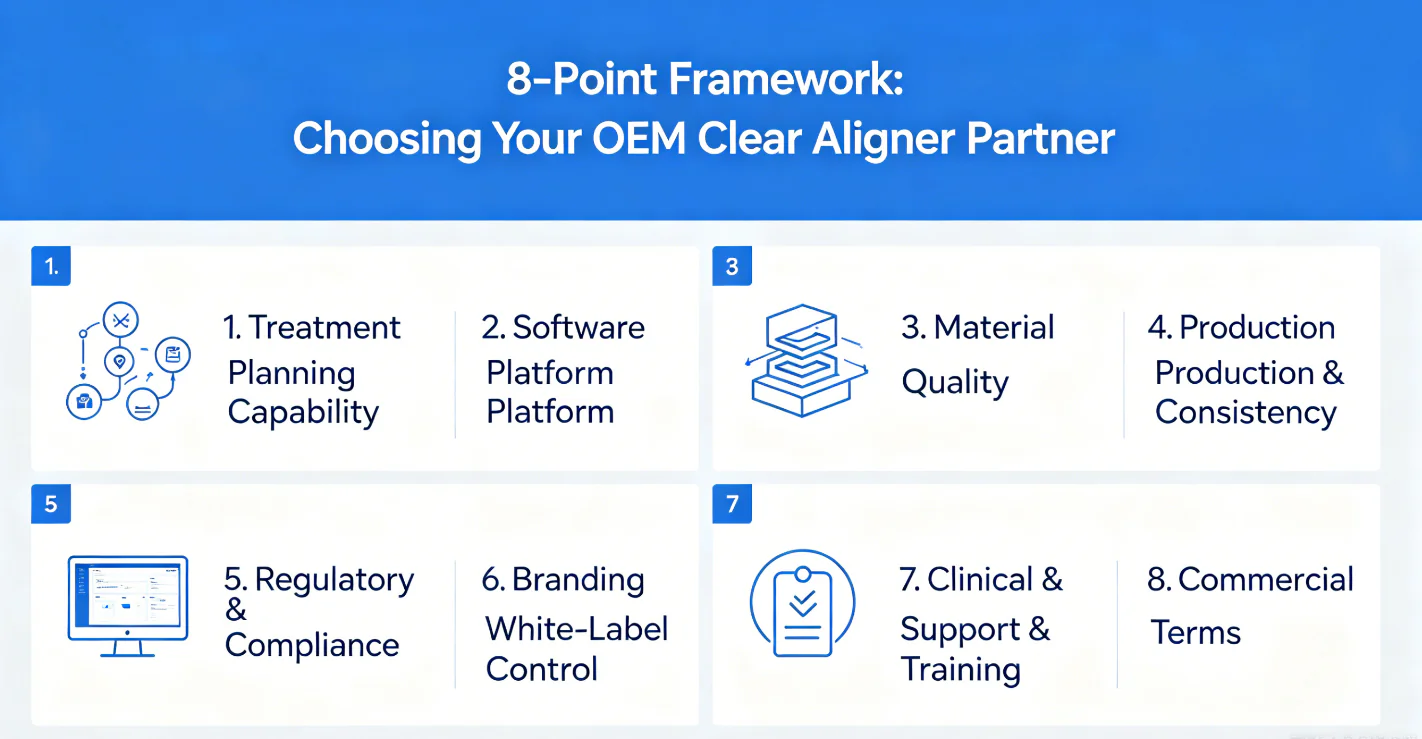
This article expands on a proven evaluation framework with eight essential criteria. Use it to move beyond sales pitches and identify the partner who will truly protect and grow your brand.
1. Treatment Planning Capability: The 60% That Drives Clinical Success
A useful principle in clear aligner therapy is the 60/20/20 rule: roughly 60% of the treatment outcome depends on the quality of the treatment plan, 20% on the dentist’s clinical execution, and 20% on patient compliance.
Your OEM partner’s treatment planning capability is therefore not just one factor among many—it is the single most important determinant of clinical success. This is especially true for moderate and complex cases: extraction cases, deep bites, open bites, and mid-course corrections demand genuine orthodontic expertise, not just software automation.
When evaluating a partner, ask:
–Do they employ orthodontically trained designers, or only entry-level software operators?
–What is their process for handling complex malocclusions? Can they demonstrate consistent outcomes?
–Do they track and share metrics such as refinement rates and clinical usability rates?
A partner with genuine design depth will welcome these questions and answer them with specificity.
2. Software Platform: AI-Powered, Cloud-Native, and CBCT-Ready
The software your OEM partner uses is the engine behind every treatment plan. The differences between platforms have direct clinical and operational consequences.
AI vs. Rule-Based Planning
Rule-based systems encode static clinical rules. They can work for simple cases but struggle with consistency and scalability. AI-powered planning—built on neural networks trained with large, clinically validated datasets—delivers:
Consistency: The same case submitted ten times generates ten functionally identical plans.
Speed: Plan generation in minutes, not hours.
Scalability: Output scales with compute capacity, not headcount.
Ask whether the partner’s software uses genuine AI (neural network-based plan generation) or merely labels a single automated feature like segmentation as “AI.”
Cloud-Native Platform
A modern OEM partner should operate on a cloud-native platform that provides:
Seamless delivery of design files and production files
Patient communication links (treatment simulations, progress tracking)
Case management and revision workflows
Real-time collaboration tools so doctors can review, comment, and request modifications without leaving the platform
This reduces turnaround time, eliminates version-control errors, and improves the clinician experience—directly strengthening their loyalty to your brand.
CBCT Integration
For moderate and complex cases, crown position alone is insufficient. The planning platform must be able to incorporate CBCT data to evaluate root position, bone boundaries, and periodontal constraints. Without this, the system defaults to cosmetic alignment rather than anatomically sound tooth movement.
3. Material Quality: The Three-Layer Standard
The aligner is the physical embodiment of your brand. Material quality directly affects patient comfort, durability, force delivery, and aesthetic performance.
Industry leaders like Invisalign, Angel Aligner, and Zendura have set a high benchmark with three-layer materials: a soft inner layer for comfort and engagement, a rigid middle layer for force application and shape retention, and a durable outer layer for stain resistance and structural integrity.
When evaluating materials, investigate:
–Does the material use a three-layer architecture with proven performance?
–How does force retention hold up over a typical two-week wear cycle?
–What is the stain resistance profile?
–Are there independent studies or certifications supporting the claims?
Cheap single-layer materials may reduce per-unit cost, but they compromise on the very things patients notice most—comfort, appearance, and treatment progress.
4. Production Capacity, Automation, and Consistency
Your ability to scale depends on your partner’s ability to deliver—on time, at volume, and with consistent quality.
Capacity Alignment
Confirm current and projected capacity. If you plan to process 1,000 cases per month within two years, a partner running a small manual production line is not a viable match. Request concrete numbers and, ideally, tour the facility.
Automation Level
Automation in printing, laser marking, trimming, and packaging reduces human error and improves consistency. Manual processes introduce variability that clinicians and patients will eventually notice.
Quality Consistency
Ask about quality control protocols, acceptable tolerances, and whether a documented quality management system is in place. The goal is not zero defects—no manufacturing achieves that—but a demonstrated ability to catch and correct issues before they reach your customer.
5. Regulatory Compliance
Your partner’s regulatory standing directly affects your brand’s legal exposure and market access.
Verify the following at a minimum:
–Material certifications: CE marking (for Europe) and/or FDA clearance (for the US) for the aligner material.
–Manufacturing facility certifications: ISO 13485 certification for quality management in medical device manufacturing. FDA registration of the facility is a strong additional signal, especially for US market entry.
6. Branding Flexibility & White-Label Control
Your OEM partner should empower your brand, not limit it. Branding control varies dramatically between providers, and the details matter.
At the most basic level, a partner may offer logo placement on generic packaging. At an advanced level, you should expect:
–Custom aligner specifications: Control over aligner thickness, trim line, and material choice.
–Custom packaging: Fully branded boxes, pouches, and patient instructions.
–Branded patient welcome kits: A curated unboxing experience that builds trust and differentiation.
–White-labeled software portals: The doctor-facing and patient-facing digital platforms carry your brand, not the OEM’s.
Define your requirements precisely before entering discussions. And equally critical: your framework agreement must state unambiguously that all treatment plans, digital designs, and patient data remain your exclusive intellectual property. Without this clause, you risk your clinical assets being used to serve competitors or the OEM’s own brand.
7. Clinical Support & Training
Software and materials are only part of the picture. Complex cases require orthodontic expertise, and your clinicians will need support.
Evaluate the OEM’s clinical team:
–What is the size and qualification level of their clinical support staff?
–Is real-time support available during your business hours, or across time zones?
–Do they offer structured training programs covering case selection, treatment plan review, attachment design, and patient communication?
Pay special attention to the refinement process. Turnaround time and cost structure for refinements directly affect your margins and your clinicians’ satisfaction. A partner with a slow or expensive refinement process will frustrate doctors and patients alike, damaging your brand.
8. Commercial Terms & Partnership Structure
Move beyond per-aligner cost and examine the total cost of ownership. A deceptively low unit price often conceals other charges. Map out every cost element:
–Setup fees
–Minimum order quantities (MOQ)
–Shipping and logistics
–Refinement pricing (per case or per aligner? capped or unlimited?)
–Technology licensing or platform access fees
–Exclusivity clauses: Are you restricted from working with other partners? Does the OEM reserve the right to work with your competitors?
The most durable partnerships align incentives. OEMs willing to tie a portion of their compensation to quality metrics—such as refinement rate or on-time delivery—are demonstrating genuine confidence in their capabilities.
Choosing a Partner, Not Just a Vendor
The eight criteria above—treatment planning depth, AI-powered cloud-native software, three-layer material quality, automated and scalable production, regulatory compliance, branding flexibility, clinical support, and fair commercial terms—form a comprehensive evaluation framework.
Few OEM partners check every box, and those that do are rarely the cheapest on a per-unit basis. But per-unit price is a poor measure of total cost. A partner that gets the plan right the first time, uses materials that perform over the full wear cycle, protects your brand identity, supports your clinicians, and keeps you compliant in every target market is not an expense. It is the foundation on which your brand’s reputation is built.
When you are ready to evaluate partners, use this framework as your checklist. The answers you receive—and the questions your prospective partner asks in return—will tell you everything you need to know.