Disclosure: This guide-Clear Aligner Lab Fees Explained 2026: What You’re Actually Paying For, is published by Best Smile Tech, a Pioneering China-based OEM clear aligner manufacturer since 2018. We have a commercial interest in how doctors think about lab fees, so we built the analysis below on published third-party data wherever possible, and we show the full math including the options that compete with us. Verify all figures against current vendor quotes before making a purchasing decision.
Start with the sticker, then read past it
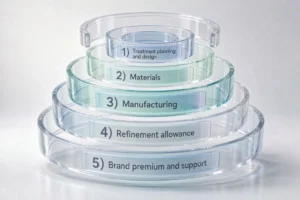
A clear aligner “lab fee” is rarely one cost. It is a bundle of five: treatment planning and design, materials, manufacturing, a refinement allowance, and brand premium. Unpack those layers and vendor pricing stops looking arbitrary.
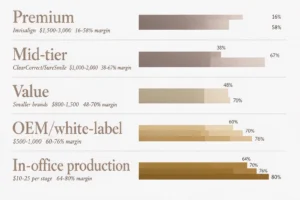
In 2026, a US doctor typically pays roughly $1,500–3,000 per comprehensive case to Invisalign, $1000–2,000 to mid-tier brands such as ClearCorrect and SureSmile, $800–1,500 to smaller alternative brands, and $500–1000 to OEM manufacturers who supply the practice direct. True in-office production runs $10–25 per aligner stage once labor and equipment are counted honestly.
The biggest lever is not shaving a few dollars off the sticker. It is knowing which bundle components you actually use. Roughly 60–65% of cases need at least one refinement, and that single line item often decides whether a case was profitable.
The five layers inside every lab fee
When a vendor quotes “$1,849 per case,” you are buying a stack. Unbundling it is the first step to paying less.
- Treatment planning and design
This is the digital setup: segmentation, staging, and attachment placement, done either by the brand’s technicians or by its software. Bought as a standalone service, planning typically runs $25–300 per case. The range is wide because it tracks treatment-plan quality, the vendor’s team labor cost, and the design platform behind the work. Design cases in-house with software such as Blue Sky Plan or ArchForm and the cost is mostly the platform’s usage fee, which keeps self-design near the low end of that range. The top of the range buys what software alone cannot guarantee: expert review. Specialist planning services run a dual-mode workflow, where an AI-assisted design is reviewed by an orthodontist or experienced technician before the STL files for aligner manufacturing are output.
- Materials
Medical-grade multilayer thermoforming film or direct-print resin. As commodities, film costs roughly $1–3 per aligner and direct-print resin about $6 per aligner. A 30-stage case carries perhaps $60–90 of physical material, which tells you the plastic is never where the money goes.
- Производство
Model printing ($0.50–2.00 per model), thermoforming, laser or manual trimming, polishing, QA, packaging. Industrial producers reach $3–8 per aligner at scale. Manual in-office workflows run $10–25 per stage once labor is in the calculation.
- Refinement allowance
Refinements are either baked into “unlimited” tiers or charged per round. This is the quiet profit-killer. With 60–65% of cases needing at least one refinement, a plan that charges $250 per round behaves very differently from one that includes them.
- Brand premium and support
Consumer marketing, doctor training, rep visits, clinical hotlines, and the pull of a name patients ask for by name. This layer is real: for practices that depend on walk-in brand demand it measurably shortens case acceptance. It is also the most negotiable part of the quote, and the part you should pay for only if you actually use it.
The 2026 lab fee tiers
| Tier | Typical lab cost per case | Примеры | GP gross margin* |
| Premium brand | $1,500–3,000 | Invisalign Comprehensive | 16–58% |
| Mid-tier brand | $1000–2,000 | ClearCorrect Unlimited, SureSmile | 38–67% |
| Value / alternative brand | $800–1,500 | Candid Pro and similar | 48–70% |
| OEM / white-label manufacturer | $500–1000 | Factory-direct partners | 60–76% |
| In-office production | $300–800 true cost** | ArchForm/BSP software + printer | 64–80% |
*Margin ranges from Dental Practice Insider’s 2026 GP aligner economics analysis, assuming $4,500–5,500 median case fees and $80 per-appointment clinical time cost.
**True cost including software, materials, equipment depreciation, and staff labor, not the “$3 of plastic” myth.
The arithmetic is hard to argue with: every $500 you strip from lab cost flows almost dollar-for-dollar into your margin, because patient fees are set by your local market, not by your vendor. Read the tiers with that in mind, then price the next section with your own case mix.
The in-office illusion: counting the real cost
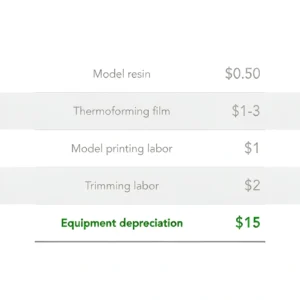
In-office production is genuinely attractive, and 64–80% gross margins are achievable. But only if you count honestly. A realistic per-aligner breakdown for a thermoforming workflow looks like this:
| Cost component | Per aligner |
| Model printing (resin + printer time) | $0.50–2.00 |
| Thermoforming film | $1.00–3.00 |
| Trimming labor (45–50 aligners/hour, fully loaded staff cost) | $1.50–3.00 |
| Wash/cure consumables, QA, packaging | $0.50–1.00 |
| Equipment depreciation + failure/downtime allowance | $1.00–3.00 |
| Software (amortized per case) | $1.00–3.00 |
| Realistic total | $5.50–15.00 |
Add doctor time and workflow inefficiency and the honest in-office range lands at $10–25 per stage. That is why some practices discover their “cheap” in-house aligners cost as much as outsourcing. The K Line Europe clinical blog makes the same point: the hidden costs of in-house production often outweigh the savings, with doctor and staff time as the limiting factor.
In-office wins on control and speed. It wins on cost only above roughly 10–15 cases per month with disciplined workflows. Below that volume, an OEM partner is usually cheaper and always simpler to staff.
The refinement math nobody shows you
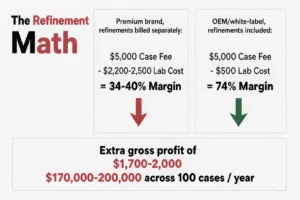
This calculation, more than any sticker price, decides your aligner P&L. Take a $5,000 case with a $1,700 premium-brand lab fee:
- Refinements included (Comprehensive tier): lab cost stays at $1,700. Margin holds near 50%.
- Refinements billed separately at $250–400 per round, with two rounds needed (unremarkable at the 60–65% baseline): lab cost becomes $2,200–2,500. Margin falls to 34–40%.
- The same case through a $500 OEM lab fee with refinements included in the partnership: even after two rounds, lab cost stays near $500. Margin approaches 74%, an extra $1,700–2,000 of gross profit per case. Across 100 cases a year, that is $170,000–200,000.
That is why experienced aligner practices negotiate refinement policy before they negotiate price. Good aligner supplier always stand out with less refinements, not just outcome, also policy with refinement policy for less refinements.
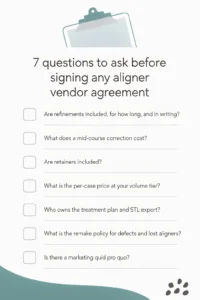
Seven questions to ask before signing any aligner vendor agreement
- Are refinements included, for how long, and in writing?“Included for three years” and “included” are different products. Get the policy from the contract, not the brochure.
- What does a mid-course correction cost if a case goes off-track?Some vendors bill this separately from refinements. It is a hidden $300–600 line.
- Are retainers included?A $400–700 surprise at case completion is common. Confirm it before you start.
- What is the per-aligner or per-case price at the volume tier you will actually occupy?Most vendors tier pricing at case volumes you may never hit. Price the tier that matches your reality.
- Who owns the treatment plan, and can you export your files?STL export freedom keeps your option to move manufacturing later.
- What is the remake policy for manufacturing defects and lost aligners?Teen cases especially: replacement aligners can be billed at full per-unit rates.
- Is there a marketing quid pro quo?Some “discounts” bundle mandatory marketing commitments or preferred-provider obligations. Know what you are trading.
Where each tier actually wins
Premium brands win when patient conversion is your bottleneck. If patients walk in asking for Invisalign by name and you would otherwise lose the case, the premium is marketing spend, not waste.
Mid-tier brands hold the balance-of-risk slot: meaningful lab savings, established clinical support, and predictable refinement policies.
OEM and white-label partners win on per-case economics and on brand-building. Your practice name goes on the box, pricing is factory-direct, and with partners such as Best Smile Tech, treatment planning, manufacturing, and refinement rounds sit inside one accountable relationship with a 48-hour design SLA.
In-office production wins on speed, control, and margin. Same-day starts lift acceptance, provided you hold the volume and the discipline.
The sophisticated 2026 play is rarely exclusive. Many thriving practices run a premium brand for the patients who demand it and an OEM or in-house pathway for everyone else, letting case mix rather than vendor loyalty drive the decision.
Frequently asked questions
What is the average lab fee for clear aligners in 2026?
In the US, roughly $1,500–3,000 per comprehensive case for Invisalign, $1000–2,000 for mid-tier brands like ClearCorrect and SureSmile, $800–1,500 for alternative brands, and $500–1000 for OEM factory-direct partners. In-office true cost runs $10–25 per aligner stage once labor and equipment are counted.
Why is Invisalign’s lab fee so much higher than alternatives?
Three reasons: the consumer brand premium (patients request it by name, which lifts your conversion rate), bundled doctor-support infrastructure, and historically limited competition. The gap is real, and for conversion-sensitive practices it is partly worth paying. Treat it as a marketing expense, not as a charge for clinical superiority.
Is making aligners in-office actually cheaper?
Only above roughly 10–15 cases per month with disciplined workflows. Materials are cheap ($1–3 per aligner for film), but model printing, trimming labor (45–50 aligners per hour per trained assistant), equipment depreciation, and failure downtime push true costs to $10–25 per stage. Below break-even volume, outsourcing to an OEM is typically cheaper and always less operationally demanding.
How do refinements affect my real lab cost?
Enormously. With 60–65% of cases needing at least one refinement round, a $250–400 per-round charge can add $500–800 to a case. Always compare vendors on “cost per finished case,” including expected refinements, rather than on headline case price.
What is the cheapest legitimate way to source aligners?
At low volume, an OEM manufacturing partner with per-case pricing in the $500–1000 range and included refinements. At high volume with capital to invest, in-office direct-print workflows can reach $6–10 per aligner. Both beat premium-brand lab fees by 60–80%.
Can I negotiate aligner lab fees?
Yes, especially on volume tiers, refinement policy, retainer inclusion, and starter-case pricing. Vendors rarely move the published sticker price, but they routinely move everything around it. Get all concessions in writing.
How much should a standalone treatment plan cost?
Roughly $25–300 per case, and the difference mostly comes down to whether you are paying a design service or just the software. Design cases in-house and the cost is mainly the platform’s usage fee, which keeps self-design at the low end of the range. Pay a planning service and you are buying a dual-mode workflow: an AI-assisted design reviewed by an orthodontist or experienced technician before the STL files for aligner manufacturing are output. On a moderate-to-complex case, that experienced expert review is usually the cheapest insurance you can buy.
Want your real per-case number? Best Smile Tech offers transparent per-case/per-aligner pricing with design, manufacturing, and a 48-hour SLA in one relationship, plus one free trial case design so you can benchmark quality before committing. Visit bestsmiletech.com. whatsapp : +86 137 15252781