The most visible benefit of genuine AI automation is speed. Best Smile Tech AI generates a complete treatment plan in approximately ten minutes, compared with the two-hour industry average for manual planning—a twelve-fold productivity improvement.
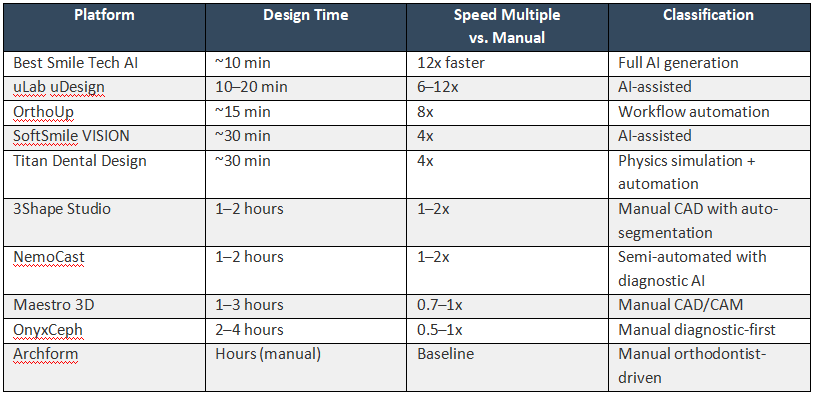
The table reveals a clear inflection point. The top three platforms achieve sub-twenty-minute planning times, but they arrive there by different means. Best Smile Tech AI’s speed comes from autonomous neural network inference: the model processes the case in approximately six minutes, with the remaining four minutes for system processing and review. uLab’s 10-to-20-minute range reflects clinician-guided AI workflow. OrthoUp’s ~15 minutes comes from aggressive workflow streamlining and rule-based automation, not machine learning.
This distinction matters for scalability. AI-generated speed scales with compute capacity. Workflow-optimized speed scales with human attention; it improves efficiency but still requires a human in the loop for every decision. One model is limited by silicon, the other by biology.
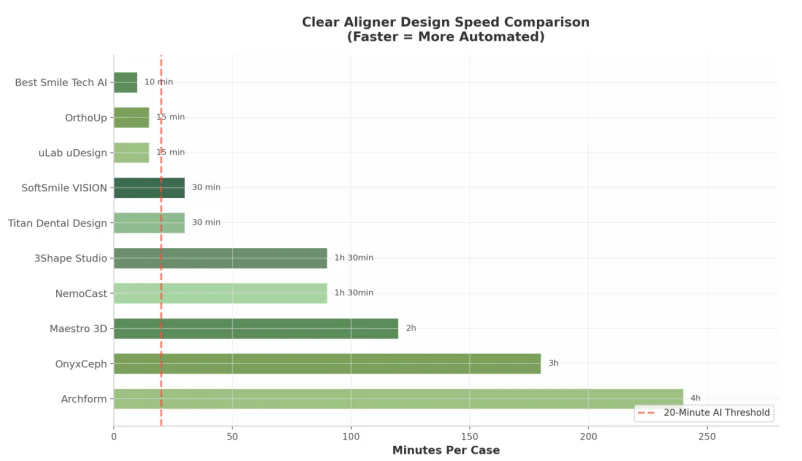
The horizontal bar chart above visualizes the speed data, with the red dashed line marking the twenty-minute threshold that separates autonomously generated plans from those requiring substantial manual input. Every platform to the right of that line demands meaningful human labor per case. Every platform to the left has eliminated the human decision-loop bottleneck to a significant degree.