Over the past several years, the global clear aligner industry has experienced unprecedented turbulence. China’s “third place” player collapsed overnight. A chain pediatric orthodontic brand shut its doors without warning. Across the Pacific, SmileDirectClub — valued at nearly $9 billion — filed for bankruptcy, while Align Technology saw its stock plummet nearly 40% in a single day. This wave of failures is no accident. It is the explosive eruption of long-concealed structural contradictions.
China’s Market: A Brutal Elimination Round
Between 2025 and 2026, China’s clear aligner market is accelerating through a dramatic shakeout. The overall market continues to grow — reaching approximately RMB 5.4 billion (USD 750 million) in 2024, up 15% year-over-year — yet the number of viable players is shrinking, with concentration tilting further toward the top two incumbents.
Klick Aligner: The Fall of the “Third Place”
On December 9, 2025, Klick Aligner — widely regarded as China’s third-ranked domestic clear aligner brand — issued a service suspension announcement. The ten-year-old company had built a network covering 1,800 cities, 50,000+ dental clinics, and 80,000 registered dentists. Its collapse was multi-causal: centralized procurement policies in 2024 undercut its price advantage in lower-tier markets; cumulative R&D exceeding RMB 400 million failed to build durable moats; and a dispersed 13-shareholder ownership structure meant critical strategic pivots were never executed in time.
The fallout was messy. Thousands of active patients faced interrupted treatment. Angelalign and Shuyaqi eventually took over some cases, but the damage to clinic-brand trust was done.
Haolijia Dental: Expansion Kills
Just months later, Haolijia Dental — a chain brand focused on early pediatric orthodontic intervention — abruptly closed locations across four cities. Founder Huang Wei candidly acknowledged the error: blind pursuit of scale, with expansion far outpacing management capacity, drained cash flow until the chain simply broke. The brand had invested heavily in an AI digital system with 170,000 pediatric case records — yet never converted that asset into revenue, a stark reminder that digital capability without clinical delivery quality is a path to nowhere.
Global Resonance: Same Script, Different Cast
China’s turbulence was not isolated. In Q2 2025, Align Technology’s stock crashed 37% in a single day; its market cap had evaporated over USD 40 billion from its 2021 peak. Invisalign’s global share dropped from a dominant 80%+ to below 60%.
In the DTC segment, the damage was even more severe. SmileDirectClub filed for Chapter 11 in September 2023 and ceased operations by December, leaving nearly USD 900 million in debt. Its “dentist-bypassing” remote model accumulated massive lawsuits due to treatment failures. Byte (Dentsply Sirona) and Australia’s SmileStyler followed similar paths.
A common logic runs through all of this: in healthcare, brands without core technological substance and clinical delivery capability — regardless of valuation — have nowhere to hide when the tide recedes.
The Real Bottleneck: Design Capacity, Not Production
Here is the inconvenient truth the industry has long ignored: the true bottleneck is not aligner manufacturing — it is treatment planning design capacity. 3D printers and thermoforming machines can be scaled with capital. Qualified treatment planners cannot.
A complete clear aligner delivery chain has four links: clinical data capture, treatment planning design (TPS), manufacturing, and clinical monitoring. Treatment planning is the technical apex. It demands the integration of biomechanical principles, physiological limits of tooth movement, material science, and individual patient conditions into a pre-planned, multi-year safe movement trajectory. Every case is a deep clinical judgment call.
Most emerging brands and DTC companies lack professional in-house design teams, forcing them to outsource TPS to low-cost remote providers. These providers rely on semi-automated AI software capable only of simple alignment cases. When confronted with extraction-based treatment, TAD assistance, vertical control, or bite reconstruction — moderate to complex cases — they “force through” with disastrous results.
This creates a vicious cycle: brands cut costs with cheap TPS → complex case quality collapses → complaints and refunds surge → brand reputation dies → further cost cuts. Everyone loses, especially the patients.
The 60-20-20 Rule
In clear aligner therapy, outcome effectiveness follows a well-established framework:
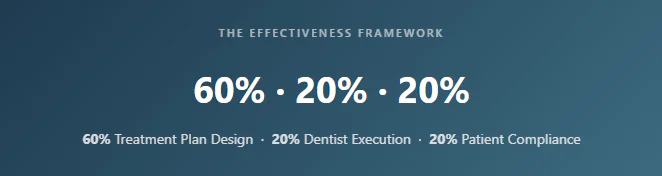
The treatment plan is the “source code” of clear aligner therapy. It determines staging, trajectory, and force application. When low-cost TPS teams process moderate and complex cases as assembly-line products, they undermine the 60% foundation. Without deep orthodontic expertise, designers are merely “dragging teeth” on a software interface — not making medical decisions.
What Effective Clear Aligner Design Capacity Actually Means
The industry talks about “capacity” as if it were a single dimension — number of designers, cases per day, output volume. This is dangerously wrong. True effective clear aligner design capacity is a multidimensional capability that most emerging brands and low-cost TPS providers simply do not possess. Here is what it actually looks like:
1
Professional Orthodontic Design Teams
Not generic dental technicians or software operators, but specialists trained in clear aligner biomechanics, attachment design, and staging optimization. Every treatment plan must pass review by clinicians who understand why teeth move — not just how to drag them in software.
2
Deep Case Experience Across Complexity Levels
A capable provider must go far beyond simple crowding or spacing cases. Effective capacity means proven competency in moderate and complex case design — extraction-based treatment, deep bite and open bite correction, crossbite resolution, TAD-assisted anchorage, skeletal discrepancies, and full-mouth reconstruction with inter-arch coordination.
3
Cloud-Based Case Delivery & Production Integration
Effective capacity is not just about designing good plans — it is about delivering them efficiently. A robust cloud platform enables seamless case submission, design iteration, dentist feedback loops, and direct production handoff. This eliminates the friction that plagues email-based, disconnected workflows where files get lost and revisions take days.
4
Direct Clinical Communication & Design Rationale
This is where most TPS providers fail entirely. An effective design partner does not just deliver a treatment plan file — they explain it. They communicate the rationale behind extraction decisions, staging sequences, attachment choices, and potential refinement triggers. They engage in back-and-forth clinical dialogue with the treating dentist, not one-way file dumps. This consultative capability is what separates a design vendor from a true clinical partner.
When you evaluate a clear aligner design partner, these four pillars are the non-negotiable criteria. A team that checks all four boxes is extraordinarily rare — and that scarcity is precisely why brands that rely on cut-rate TPS are facing the reckoning we see today.
The hard truth: The market is flooded with TPS teams that can handle simple aligner cases using automated tools. But when it comes to moderate and complex clear aligner case design — the cases that truly differentiate a brand and generate long-term patient loyalty — the vast majority of low-cost providers are simply not qualified. They lack the clinical expertise, the communication infrastructure, and the quality assurance systems to deliver consistent outcomes. That is the gap BEST SMILE TECH and a handful of specialized OEMs fill.
The Education Gap and the 70% Opportunity
Behind the design capacity crisis lies a deeper structural issue: dental education globally is still overwhelmingly rooted in traditional fixed orthodontics. Clear aligner education, as a systematic discipline, only emerged in the past decade. The result? Two critical consequences:

The 70% traditional share is not a sign of clear aligner immaturity — it signals a massive conversion opportunity. For leading brands like Invisalign and Angelalign, this is the core battlefield. For professional OEMs like BEST SMILE TECH with proven moderate and complex case delivery capability, it is an equally vast blue ocean.
Building Walls in Chaos
The more chaotic the market, the more valuable genuine capability becomes. Companies like BEST SMILE TECH — with teams of professionally trained orthodontic reviewers, full-spectrum digital orthodontic design capability, and ISO 13485-certified manufacturing — represent scarce infrastructure in an industry hemorrhaging trust.
Global design capacity capable of reliably delivering moderate and complex cases is extremely scarce. It cannot be solved by adding 3D printers. It requires years of accumulated clinical knowledge, design experience, and quality control. Those who persistently invest in medical substance and design capacity will define the next decade.
The Sky Will Be Clearer After the Storm
The clear aligner industry is undergoing a painful but necessary maturation. The fall of Meilikesi, Haolijia, and SmileDirectClub represent the inevitable cost of transitioning from chaotic growth to disciplined operation.
The core truth exposed: clear aligners are medical devices, not consumer goods. They are clinical medicine, not software algorithms. When capital’s tide recedes, those who remain will be the ones who respected medical substance, built design capacity, and safeguarded treatment quality.
For the dental community, accelerating clear aligner education is the key to unlocking the 70% untapped market. For the “wall-builders” who understand what “capacity” truly means — the storm is not the endgame. It is the starting point of a new era.