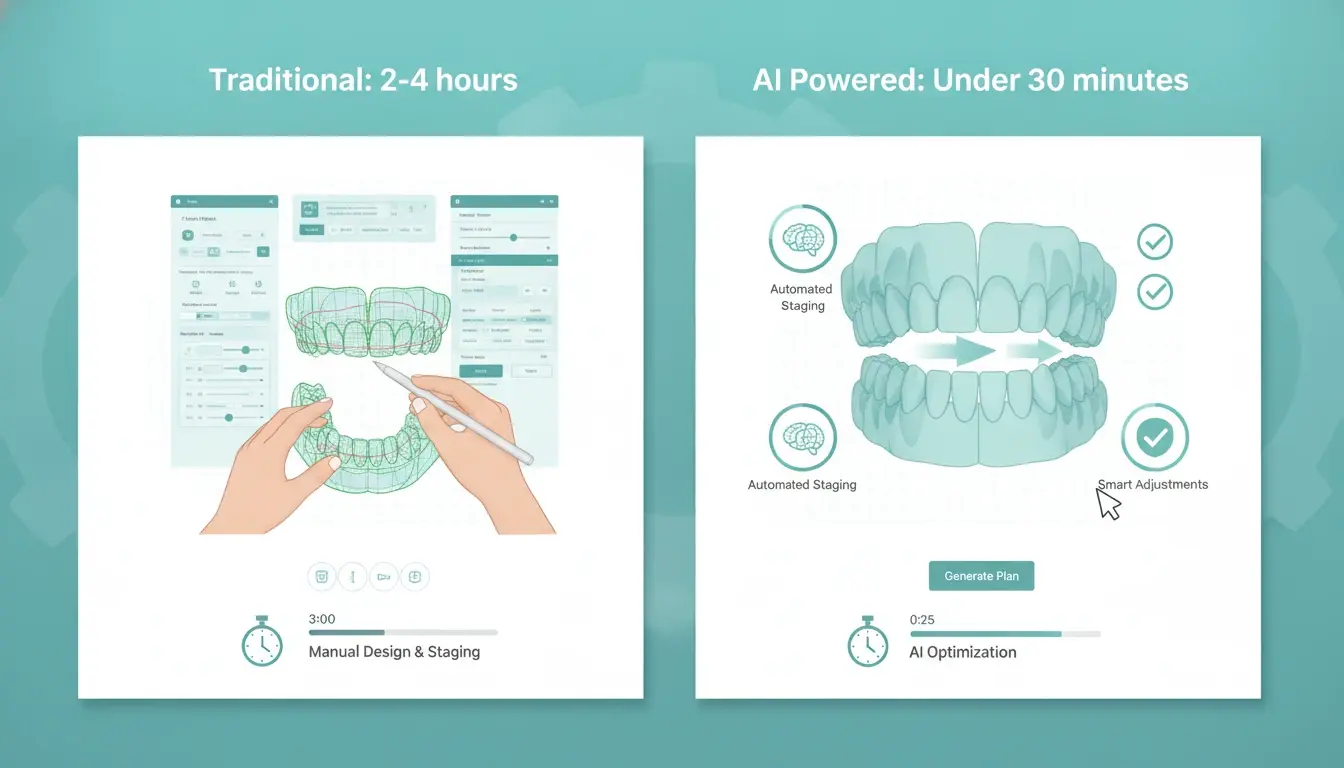
Clear aligner treatment planning has long been the most labor-intensive phase in the orthodontic workflow. A single moderate-to-complex case can consume 2 to 4 hours of meticulous tooth segmentation, stage-by-stage setup, and force calibration. For high-volume practices and orthodontic labs, these hours multiply quickly, creating a ceiling on how many patients can be started per week.
Artificial intelligence is changing this equation. Purpose-built AI clear aligner design software — developed specifically for orthodontic workflows rather than adapted from generic CAD platforms — is now capable of compressing entire planning cycles from hours to minutes. This article examines how AI-driven automation works, what distinguishes native orthodontic AI from general-purpose tools, and how practices can evaluate solutions that deliver real speed without sacrificing clinical precision.
The Treatment Planning Bottleneck
Traditional treatment planning follows a sequential, manual process. Technicians begin by segmenting each tooth from the digital model, then position every tooth individually across dozens of treatment stages, verify collision points, adjust force vectors, and iterate based on clinical feedback. Each step demands specialized expertise and focused attention.
The challenges compound at scale. Fragmented assembly-line workflows — where different technicians handle different stages of the same case — introduce handoff errors and inconsistent treatment logic. Multi-location clinics face additional coordination delays. The result is predictable: longer turnaround times, higher labor costs, and a practical limit on case volume that has little to do with clinical capacity.
What AI Clear Aligner Design Software Actually Does
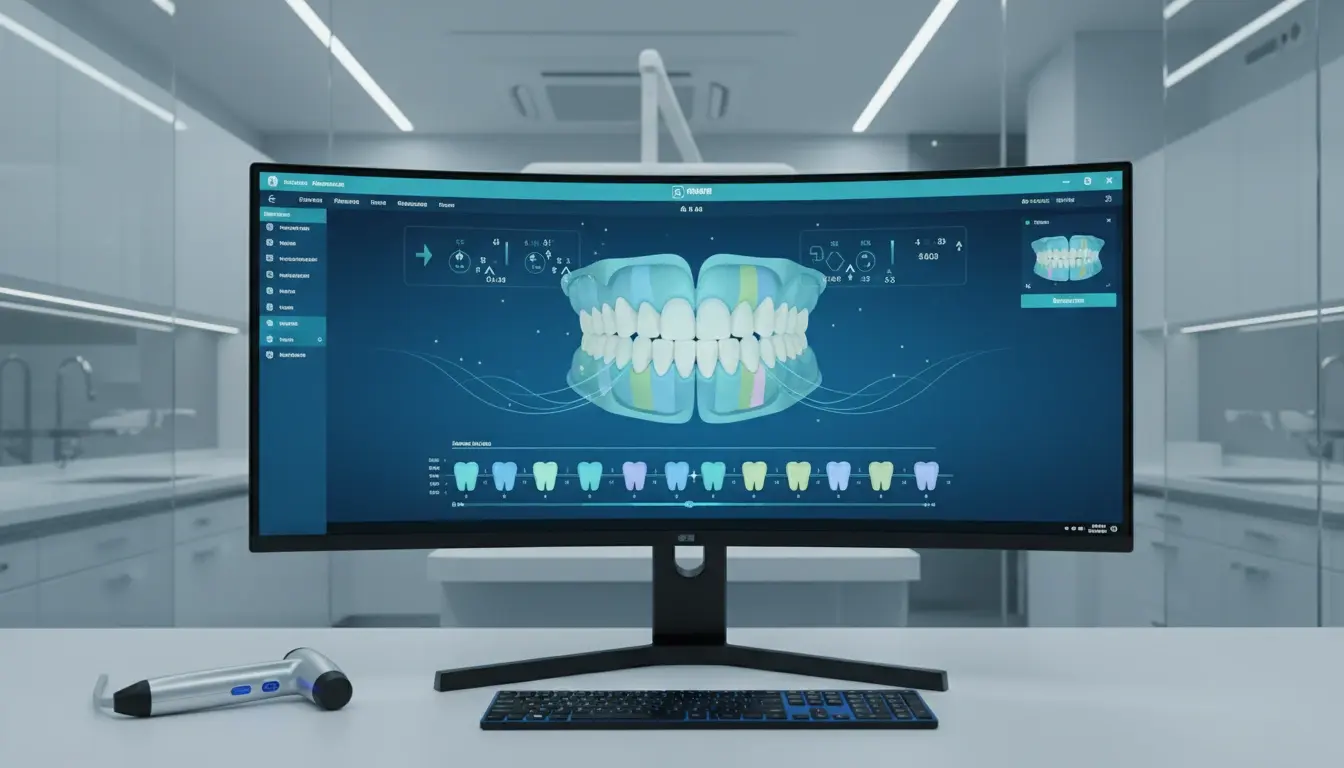
AI orthodontic design platforms automate the three most time-consuming steps in treatment planning: segmentation, staging, and collision-aware path optimization. Understanding each function helps clarify where the time savings originate.
Automated Segmentation & Intelligent Staging
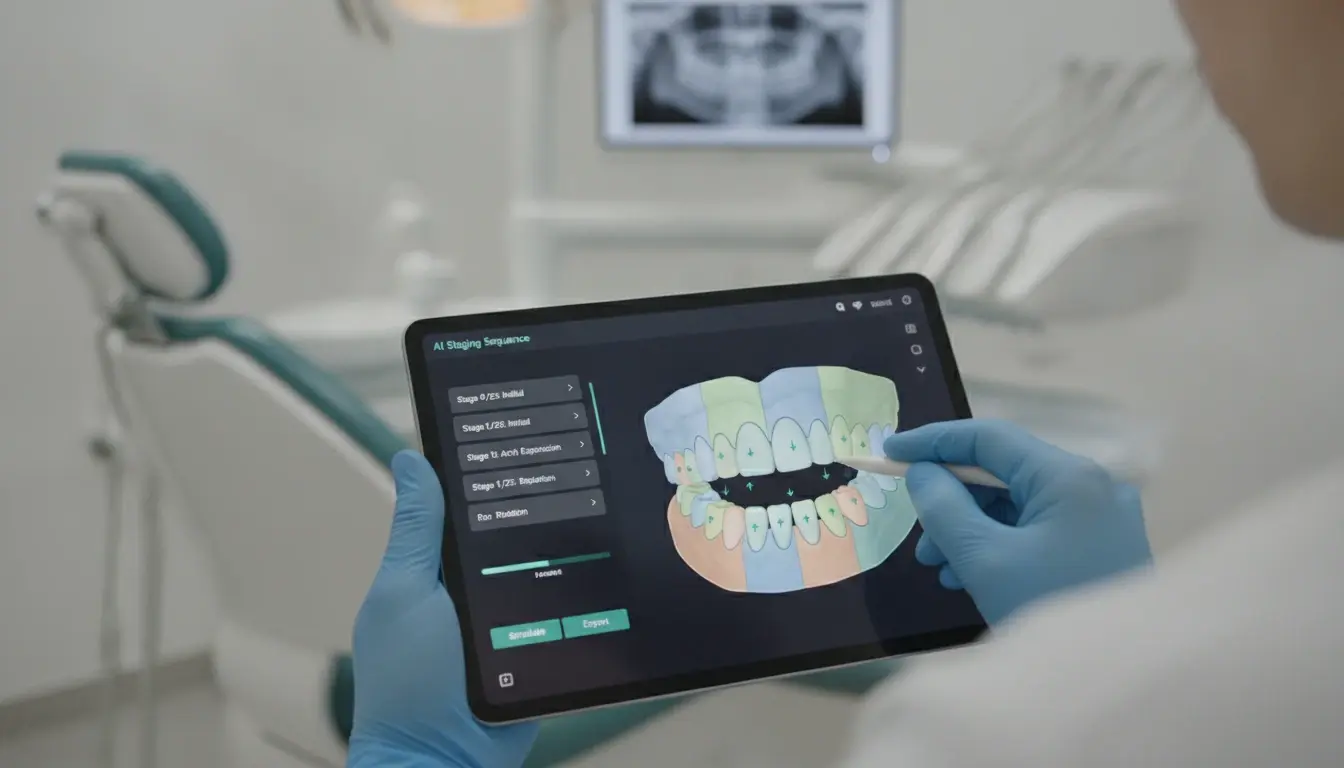
Manual tooth segmentation requires isolating each tooth from the gingival margin and surrounding structures — a precise but repetitive task. AI systems trained on large orthodontic datasets perform this segmentation automatically in seconds, with accuracy that matches or exceeds manual methods. Once segmented, the AI generates a clinically sequenced treatment plan by drawing on pattern recognition from thousands of previously completed cases, proposing optimal movement sequences and stage counts without human intervention.
Collision Detection & Path Optimization
A critical and often underestimated step is collision detection: identifying where adjacent teeth would intersect during movement and calculating alternate paths. AI software continuously evaluates these spatial relationships across all stages, flagging potential issues before they reach production. This predictive capability not only accelerates planning but also reduces the refinements that plague many aligner treatments — refinement cycles that can add weeks to overall treatment duration and erode patient satisfaction.
Purpose-Built AI vs. Adapted CAD Frameworks
Not all AI-powered dental tools are created equal. A meaningful distinction exists between orthodontic software built from the ground up with domain-specific AI models and general-purpose CAD or 3D design platforms retrofitted with dental plugins.
Adapted frameworks typically rely on generic geometric algorithms that know teeth are 3D objects but lack deep orthodontic knowledge — optimal movement velocities, biological constraints on root positioning, or case-type-specific staging patterns. Users of these systems frequently find themselves performing extensive manual corrections, which erodes much of the promised time savings.
Purpose-built AI orthodontic platforms, by contrast, embed clinical intelligence directly into the design engine. BEST SMILE TECH’s AI-native clear aligner design software draws from 100,000+ completed cases data sets(with CBCT data) — enabling the system to recognize nuanced movement patterns, predict outcomes for challenging malocclusions, and propose staging sequences refined by real clinical data. The difference is measurable: planning cycles that took hours are completed in minutes, with output quality that maintains or improves upon manual design standards.
Measurable Results: Speed Without Compromise
The practical impact of AI-driven planning extends beyond the design desk. When planning time drops from hours to minutes, several downstream benefits emerge. Clinicians can review and approve plans faster, reducing the interval between case submission and patient start. Labs can process higher case volumes without proportional staffing increases. And because AI-native systems incorporate collision detection and outcome prediction from the outset, refinement rates tend to fall — shortening overall treatment duration and improving patient experience.
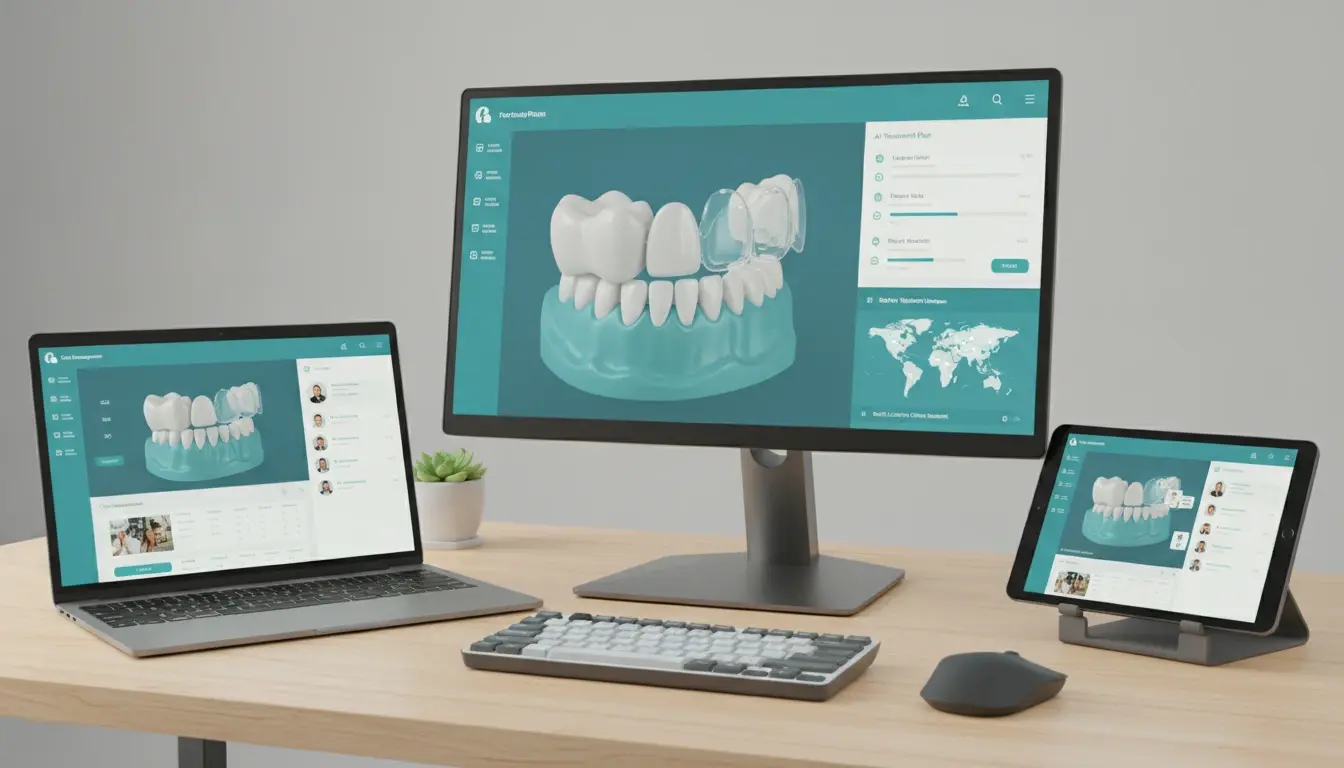
At BEST SMILE TECH, the integration of AI design software with cloud-based collaboration tools and a one-designer-per-case workflow enables treatment plan delivery within 48 hours. Advanced aligner material engineering further reduces per-step wear time from the industry-standard 14 days to 10 days, cutting total treatment duration by nearly 30%. The cumulative effect is a workflow that is faster at every stage — from initial scan to final aligner delivery.
AI clear aligner design software represents a genuine inflection point for orthodontic practices and aligner manufacturers. By automating segmentation, staging, and collision detection, purpose-built AI platforms eliminate the repetitive manual work that has historically constrained planning throughput. The key for decision-makers is to distinguish true orthodontic-native AI — trained on real case data and engineered for clinical accuracy — from generic design tools with superficial dental adaptations. The right platform delivers speed without compromise, turning treatment planning from a bottleneck into a competitive advantage.
See the AI Difference in Action
BEST SMILE TECH offers AI-powered clear aligner design software, treatment planning services, and OEM manufacturing solutions for orthodontic practices, labs, and aligner brands worldwide. Contact us today to schedule a personalized demonstration and discover how our AI-native platform can transform your planning workflow.
| Email: info@bestsmiletech.com
Phone: +86 13715252781 Web: www.bestsmiletech.com |
Contact: Angela (angela@bestsmiletech.com)
Location: Shenzhen, China Serving Global Partners |
Speak with Angela directly for partnership inquiries and technical consultations.